

The Mechanics of Vehicle Winch-Outs: How Recovery Equipment Works
Introduction
A vehicle can become stuck in a ditch, slide off a wet road, sink into soft ground, or lose traction on a muddy shoulder without suffering major mechanical damage. Getting it moving again, however, is not always as simple as pressing the accelerator. Spinning the tires can dig the vehicle deeper, damage components, and make recovery more difficult.
That is where a vehicle winch-out comes in. A winch-out uses specialized recovery equipment to apply controlled pulling force and help move a stuck vehicle toward safer, more stable ground. The process depends on the vehicle's weight, the surface beneath it, the direction of the pull, and the equipment selected for the job.
Understanding how vehicle winch-out services in Marrero, LA work helps drivers recognize when professional recovery is necessary and why proper equipment matters. For motorists in Marrero, Harvey, Gretna, Westwego, and surrounding Louisiana communities, knowing what happens during a vehicle recovery can also make an unexpected roadside emergency less confusing.
What Is a Vehicle Winch-Out?
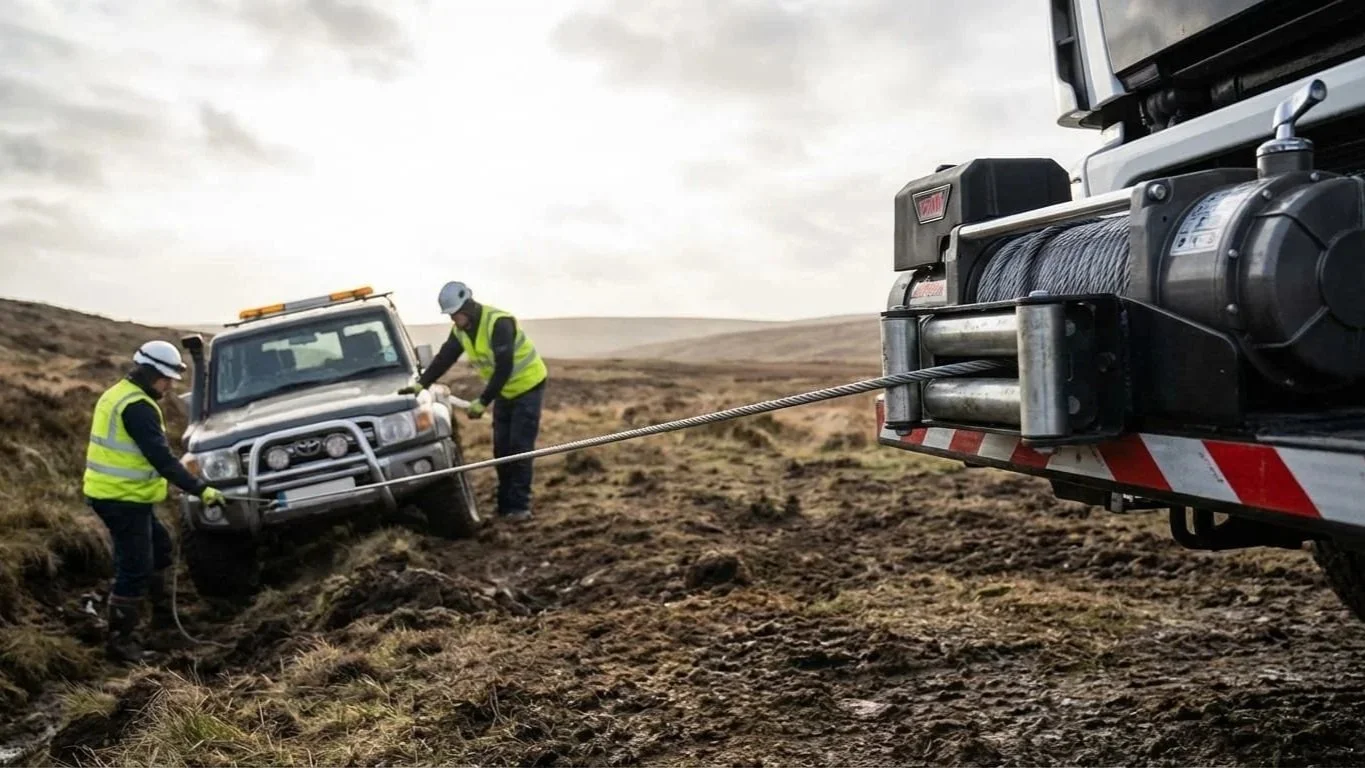
A vehicle winch-out is a recovery procedure in which a mechanical winch pulls a stuck vehicle out of a difficult position using a cable, wire rope, or synthetic line. The winch is usually mounted to a recovery truck or another suitable anchor system, allowing the operator to apply steady pulling force instead of relying on the vehicle's tires for traction.
Winch-outs are commonly used when vehicles become immobilized in mud, sand, shallow ditches, soft shoulders, or other locations where driving out under their own power may be unsafe or ineffective.
Unlike ordinary towing, which generally transports a vehicle from one location to another, a winch-out focuses on freeing the vehicle from its current position. Once it is recovered, the operator can assess whether it is safe to drive or needs additional towing.
Situations That May Require a Winch-Out
Several roadside situations can make winch-assisted recovery necessary:
Mud and soft ground: Rain-soaked soil can allow tires to sink and lose traction.
Roadside ditches: A vehicle that slides off the pavement may become trapped at an angle.
Gravel or sandy shoulders: Loose surfaces can prevent tires from gaining enough grip.
Flood-prone areas: Standing water can conceal soft ground, drainage channels, or other hazards.
Snow or slippery surfaces: In regions where these conditions occur, a vehicle may become immobilized without a suitable traction surface.
Uneven terrain: A vehicle can become high-centered when its underside rests on a raised section of ground.
The recovery method depends on the circumstances. A vehicle resting on firm, level ground may need only a simple repositioning, while one deep in a ditch or resting against an obstacle may require a more carefully planned extraction.
How Vehicle Winch Recovery Equipment Works
A recovery winch converts mechanical power into pulling force. Although designs vary, most vehicle recovery systems contain a power source, a rotating drum, a cable or rope, and a control mechanism.
The operator connects the recovery line to an appropriate attachment point on the stuck vehicle. As the winch operates, the drum rotates and draws in the line, gradually pulling the vehicle toward the recovery vehicle or another suitable anchor.
The winch does not need to move the stuck vehicle quickly. Its purpose is to generate controlled pulling force while the operator monitors the vehicle's position, the recovery line, and the surrounding conditions.
The Winch Motor and Power Source
Many recovery winches use an electric motor powered by a vehicle's electrical system. Other systems use hydraulic power, often supplied by equipment on a recovery truck.
Electric winches are commonly found on lighter recovery vehicles and off-road equipment. Hydraulic systems can be suitable for demanding commercial applications, depending on their design and rated capacity.
The power source determines how the winch operates, but it does not alone determine whether the system is suitable for a particular recovery. The operator must also consider rated pulling capacity, line condition, available power, mounting strength, and the demands of the extraction.
The Drum, Cable, and Fairlead
The drum stores the recovery line as it winds in or pays out. The line may consist of steel wire rope or synthetic rope, with each type requiring appropriate handling and inspection.
A fairlead guides the line onto the drum and helps prevent uneven winding. Depending on the design, it may use rollers or a smooth opening suited to the line material.
Correct line management matters because tangled or unevenly wound cable can interfere with operation. Damaged wire rope, frayed synthetic rope, corroded fittings, and other signs of wear can also compromise recovery safety.
Controls, Brakes, and Mounting Equipment
Winch controls allow the operator to engage, stop, and regulate the pulling process. A braking mechanism helps hold the load when the winch stops, although the specific design and operating limits vary by equipment.
The winch mounting system is equally important. Even a high-capacity winch cannot safely perform a recovery if its mounting structure or supporting vehicle is unsuitable for the forces involved.
Professional operators consider the entire recovery system rather than treating the winch as an isolated piece of equipment.
Step by Step: What Happens During a Professional Winch-Out?
A vehicle recovery generally follows a planned sequence. The exact steps depend on the location, vehicle condition, and hazards present, but the underlying goal remains the same: free the vehicle without causing unnecessary damage or putting people at risk.
Step 1: Assess the Vehicle and Surrounding Area
The operator first examines how the vehicle became stuck and what is preventing it from moving. This includes checking its position, the slope of the ground, tire placement, visible damage, and the condition of the surface.
A vehicle sitting partly in a ditch presents different challenges from one buried in mud on level ground. The operator must also identify nearby traffic, drainage channels, obstacles, overhead hazards, and unstable soil.
If the vehicle is submerged, close to moving water, near electrical hazards, or in an unstable position, additional precautions or specialized vehicle recovery resources may be necessary.
Step 2: Select the Appropriate Recovery Method
The operator determines whether a winch-out is suitable or if another approach is safer. Depending on the circumstances, recovery might involve a flatbed towing truck, a compatible wheel-lift system, approved recovery straps, or specialized equipment.
Vehicle weight is only one consideration. The resistance created by mud, a slope, buried tires, or contact with an obstacle can substantially increase the force needed to move the vehicle.
The operator must also identify suitable attachment points and determine whether the vehicle has structural or mechanical damage that could make pulling unsafe.
Step 3: Position the Recovery Vehicle
The recovery truck needs a stable position that supports the intended direction of pull. The operator considers the ground beneath the truck, the alignment of the recovery line, and the possibility that the stuck vehicle could shift unexpectedly.
A straight pull is often preferable when the site allows it because sharp angles can introduce side loads and increase equipment stress. If the situation requires a different pulling direction, the operator must use equipment and rigging designed for that configuration.
The recovery vehicle must also be secured appropriately. Its position and stability are part of the recovery plan, not an afterthought.
Step 4: Connect the Recovery Line
The line is attached to a suitable, manufacturer-approved recovery point on the stuck vehicle. The correct attachment point depends on the vehicle's design and the intended direction of force.
A decorative bumper, suspension component, steering part, or ordinary transport tie-down may not be designed to withstand recovery loads. Attaching a line to an unsuitable point can damage the vehicle or cause the attachment to fail.
Where necessary, the operator uses compatible recovery hardware, such as appropriately rated shackles or connectors. Every component must be suitable for the forces and configuration involved.
Step 5: Apply Controlled Pulling Force
Once the setup has been checked, the operator begins the pull gradually. The winch draws in the line while the operator watches for movement, changes in vehicle position, and signs that the equipment or ground is becoming unstable.
The driver may be asked to steer or follow specific instructions if doing so is safe and appropriate. Heavy acceleration is generally avoided because excessive wheelspin can dig the tires deeper or create unpredictable movement.
If the vehicle does not move as expected, the operator may stop and reassess the setup instead of simply increasing the force.
Step 6: Move the Vehicle Onto Stable Ground
As the vehicle becomes free, the operator guides it toward a suitable position. The goal is not merely to remove it from the ditch or mud but to reach a location where it can be safely inspected and handled.
The operator may need to adjust the pulling direction or reposition equipment during a complicated extraction. Any change in the setup requires attention to line alignment, attachment points, and the stability of the recovery vehicle.
Once the vehicle is free, the operator checks whether additional recovery work or roadside assistance is required.
Step 7: Inspect the Vehicle Before Driving
A successful winch-out does not automatically mean the vehicle is safe to drive. The driver should look for warning lights, fluid leaks, tire damage, abnormal steering, and visible damage underneath the vehicle.
A hard impact with a ditch or curb can damage suspension, wheels, underbody components, or steering parts. Water exposure can also create electrical and mechanical problems that are not immediately obvious.
If the vehicle has significant damage, unusual noises, compromised steering or braking, or possible water-related engine damage, arranging a tow to a repair facility is safer than driving away.
The Main Types of Recovery Equipment
Different recovery tools serve different purposes. The appropriate equipment depends on the vehicle, the terrain, the available anchor points, and the forces expected during extraction.
Electric and Hydraulic Winches
Electric winches use electrical power to rotate the drum. They can be suitable for many light-duty and off-road recovery applications, provided their capacity and installation meet the demands of the job.
Hydraulic winches use hydraulic pressure to operate. They may be selected for commercial recovery systems where the truck and equipment are designed for that type of operation.
Neither type is automatically right for every situation. Proper capacity, condition, mounting, and operating procedures matter more than the power source alone.
Steel Wire Rope and Synthetic Winch Line
Steel wire rope is durable and commonly used in demanding recovery environments, but it can develop broken wires, kinks, corrosion, and other damage. It also requires careful handling to avoid injuries from sharp strands.
Synthetic winch line is generally lighter and easier to handle, although it can be vulnerable to abrasion, cuts, heat, and chemical contamination. It must be inspected and used according to the manufacturer's guidance.
Both types require compatible equipment, proper spooling, and routine inspection. A damaged line should not be used simply because the recovery appears straightforward.
Recovery Straps, Shackles, and Snatch Blocks
Recovery straps and winch lines are not interchangeable in every application. A strap designed for a particular recovery method may not be suitable for winching, and elastic kinetic recovery straps should never be treated as ordinary tow lines.
Shackles and other connectors link compatible components. Their working limits and intended uses must match the recovery arrangement.
A snatch block is a pulley-like device that can redirect a winch line. In a properly designed rigging arrangement, it may also provide a mechanical advantage that reduces the pulling force required from the winch while increasing the amount of line that must be pulled. The actual load on each component depends on the geometry and friction in the system.
These tools are not shortcuts around safe recovery planning. Every connection, anchor, and change in pulling direction affects the forces involved.
Winch-Outs vs. Traditional Towing: What's the Difference?
Winch-outs and towing are related services, but they solve different problems.
A winch-out is primarily used to free a vehicle from a position where it cannot move safely under its own power. Traditional towing transports a vehicle after it has been immobilized, damaged, or otherwise deemed unsuitable to drive.
For example, a sedan stuck in a muddy shoulder might be recovered with a winch and then driven away if it is undamaged and safe. A vehicle with a broken suspension may first require recovery from a ditch and then need flatbed towing to a repair shop.
Flatbed towing can be particularly appropriate for damaged vehicles, all-wheel-drive models, and certain vehicles whose manufacturers specify that all wheels must remain off the road during transport. The correct method depends on the vehicle's drivetrain, condition, and manufacturer instructions.
A roadside assistance provider may recommend a winch-out, towing, or a combination of both after assessing the circumstances.
Common Mistakes That Make Vehicle Recovery More Dangerous
Attempting to free a stuck vehicle without understanding the forces involved can turn a manageable problem into a serious incident.
Spinning the Tires Repeatedly
Excessive wheelspin can dig deeper holes, compact mud around the tires, and increase the risk of overheating components. A vehicle that initially needs a small amount of assistance may become much harder to recover after repeated unsuccessful attempts.
Drivers should stop if the tires keep spinning without producing useful movement.
Attaching Recovery Equipment to the Wrong Point
A bumper cover or suspension component may not be designed for recovery loads. Even a component that looks solid can fail when force is applied in an unexpected direction.
Use only appropriate recovery points and compatible hardware. If the correct point cannot be identified, a qualified operator should assess the vehicle before pulling.
Standing Near a Tensioned Line
A loaded winch line stores energy. If a line, connector, or anchor fails, components can move suddenly and cause severe injury.
People should remain outside the recovery area and away from the line's path. Operators should follow the equipment manufacturer's safety instructions, use appropriate protective measures, and never step over or handle a tensioned line.
Using an Unsuitable Anchor
A tree, fence post, signpost, or another vehicle is not automatically a safe anchor. The anchor must be capable of handling the forces involved, and its stability must be assessed before use.
Improvised connections can damage property or cause equipment to break free. Professional recovery planning reduces reliance on guesswork.
Ignoring Hidden Vehicle Damage
A vehicle may look normal after being pulled onto the road while still having damaged tires, suspension parts, underbody components, or electrical systems.
If the vehicle was submerged, struck an obstacle, or experienced a hard landing, a proper inspection may be needed before driving.
How Louisiana Weather and Road Conditions Affect Winch-Outs
Roadside recovery in southeastern Louisiana can involve rain-soaked shoulders, soft soil, drainage ditches, and low-lying areas that retain water. These conditions can affect both the stuck vehicle and the recovery truck.
A vehicle may slide onto a soft shoulder after a sudden downpour, while a muddy access road can prevent tires from gripping the surface. Water can also conceal the depth of a ditch or the condition of the ground beneath a vehicle.
Recovery planning must account for the local environment. The operator may need to choose a different position, use equipment suitable for the terrain, or avoid a pulling direction that could cause the vehicle to roll or slide farther.
Floodwater requires particular caution. Drivers should never enter moving or potentially deep floodwater to retrieve a vehicle, and a vehicle exposed to water should not be restarted until the possibility of engine or electrical damage has been assessed.
For motorists in Marrero, Harvey, Gretna, Westwego, and nearby communities, communicating the vehicle's exact location and describing the ground conditions can help a roadside assistance provider determine what resources may be needed.
How to Prepare for a Vehicle Winch-Out
Drivers can make a roadside recovery easier to coordinate by sharing accurate information and avoiding actions that increase the risk.
Before calling for assistance, if it is safe to do so:
Provide your exact location: Share the street name, nearby intersection, landmark, or other useful location details.
Describe the vehicle: Give its make, model, approximate size, and whether it is loaded.
Explain how it became stuck: Mention whether it is in mud, a ditch, soft grass, sand, or another difficult area.
Report visible damage: Tell the operator if a wheel appears bent, the bumper is detached, or the vehicle struck an obstacle.
Mention nearby hazards: Explain if the vehicle is near moving traffic, standing water, unstable ground, or a steep slope.
Follow safety instructions: Keep occupants away from traffic and the recovery area, and do not attach improvised equipment while waiting.
If the vehicle is in an active traffic lane or another dangerous position, prioritize personal safety and contact emergency services when the situation warrants it. Do not stand behind or beside a vehicle that could slide unexpectedly.
Conclusion
Vehicle winch-outs rely on controlled pulling force, suitable recovery equipment, careful positioning, and a clear understanding of the vehicle's condition. The winch motor, drum, recovery line, connectors, and mounting system all work together, but safe results depend on selecting and using the complete system correctly.
The right approach begins with assessing the terrain and the vehicle, choosing an appropriate recovery method, securing compatible attachment points, and applying force gradually. Once the vehicle is free, checking for hidden damage is just as important as getting it back onto stable ground.
If a vehicle becomes stuck in a ditch, mud, or a soft roadside shoulder in Marrero, Harvey, Gretna, Westwego, or surrounding Louisiana areas, professional roadside recovery can help address the situation with equipment suited to the job. Avoid risky improvised pulls, communicate the conditions clearly, and prioritize safety throughout the recovery.
Frequently Asked Questions
1. What is a vehicle winch-out?
A vehicle winch-out is a recovery procedure that uses a mechanical winch and a cable or rope to pull a stuck vehicle out of mud, a ditch, sand, or another difficult position. The equipment applies controlled force to help move the vehicle onto stable ground.
2. How does a vehicle recovery winch work?
A recovery winch uses an electric motor, hydraulic system, or another power source to rotate a drum. The drum winds in a connected cable or rope, generating pulling force that helps move the stuck vehicle. Safe operation depends on equipment capacity, secure attachment points, and proper positioning.
3. Can a winch pull a car out of a ditch?
Yes, a winch may be able to recover a car from a ditch if the vehicle's position, ground conditions, and available equipment allow a safe extraction. The operator must assess the risk of sliding, rolling, structural damage, and unstable ground before selecting the pulling direction.
4. Does a winch-out damage a vehicle?
A properly planned winch-out should aim to minimize damage, but damage is possible if the vehicle is pulled from an unsuitable point or subjected to excessive force. Existing underbody, suspension, bumper, or wheel damage can also affect the recovery method.
5. What is the difference between a winch-out and towing?
A winch-out frees a vehicle that is stuck or trapped, while towing transports a vehicle to another location. Some situations require both services: a vehicle may first need to be pulled out of a ditch and then loaded onto a tow truck because it is unsafe to drive.
6. Is a winch-out possible in deep mud?
A winch-out may be possible in deep mud, but the difficulty depends on how deeply the vehicle is buried, the ground's stability, the vehicle's weight, and the available recovery equipment. An operator may need a specialized setup or a different recovery method if the vehicle is deeply embedded.
7. Can I use my own vehicle to pull a stuck car out?
Using another vehicle for recovery can be dangerous if the anchor points, equipment, vehicle positions, or pulling forces are unsuitable. Ordinary tow hooks and transport straps may not be designed for the loads involved. Professional assessment is advisable when the recovery setup is uncertain.
8. How long does a vehicle winch-out take?
The time required varies with the vehicle's position, terrain, accessibility, equipment, and complexity of the recovery. A straightforward extraction may be relatively quick, while a vehicle deep in a ditch or unstable mud may require additional preparation and a more involved recovery plan.
9. Should I drive my car immediately after a winch-out?
Only if the vehicle is safe to operate. Check for visible damage, fluid leaks, tire problems, warning lights, and unusual steering or braking behavior. If the vehicle was submerged, struck an obstacle, or has possible suspension or engine damage, arrange a professional inspection or towing rather than driving it.
