What Should You Do if Your Car Is Stuck in a Tight Residential Driveway?
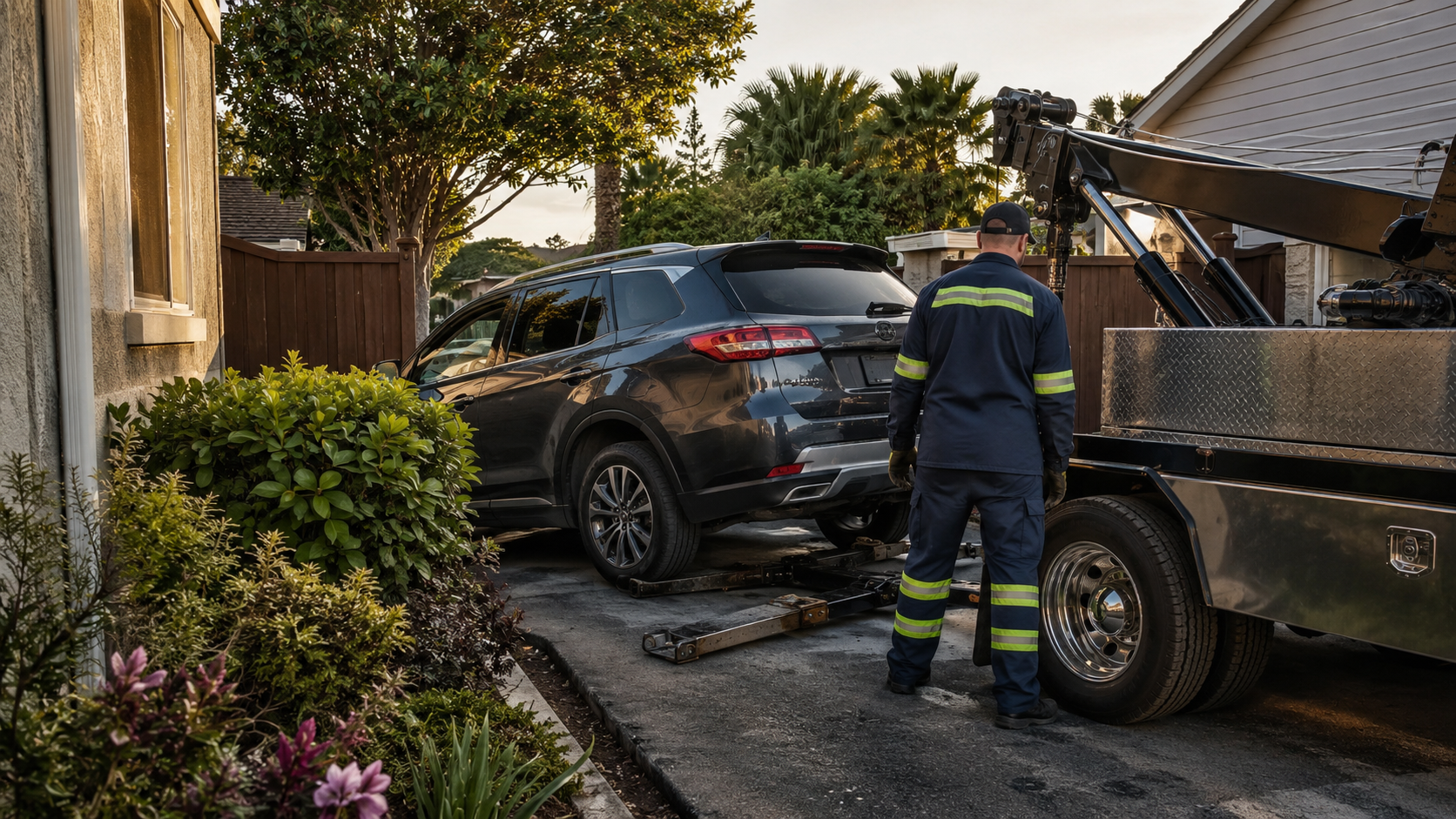
Getting a car stuck in a tight residential driveway can be frustrating, especially when there is little room to maneuver. A narrow driveway, steep incline, parked vehicles, landscaping, walls, fences, or other obstacles can make a simple mistake much harder to correct.
Your first instinct may be to keep turning the steering wheel, reverse repeatedly, or press the accelerator to force the vehicle into a better position. However, these actions can sometimes make the situation worse or cause contact with nearby objects.
The safest approach is to stop, assess the situation, and determine whether the vehicle can be moved without causing damage. If the vehicle is genuinely stuck or there is not enough room to maneuver safely, professional towing or vehicle recovery assistance may be the better option.
A&Z Towing provides vehicle recovery and towing services in Marrero and surrounding Louisiana communities.
Quick Answer
If your car is stuck in a tight residential driveway, stop and assess the vehicle's position before trying to force it out. Avoid excessive acceleration, repeated steering, or contact with nearby objects. If you cannot safely maneuver the vehicle, contact a professional towing or vehicle recovery service for assistance.
Key Takeaways
Stop moving the vehicle if you are unsure how to get out safely.
Check the space around the vehicle before attempting another maneuver.
Avoid excessive acceleration when the vehicle is stuck.
Use small, controlled steering movements rather than repeated corrections.
Watch for walls, fences, parked vehicles, landscaping, and other obstacles.
Do not repeatedly spin the tires if the vehicle has lost traction.
Ask passengers to help guide you when it is safe to do so.
Professional recovery may be appropriate when the vehicle cannot be safely repositioned.
A&Z Towing provides vehicle recovery, towing, and roadside assistance in Marrero and surrounding Louisiana communities.
Why Tight Driveways Can Be Difficult to Navigate
Residential driveways are not always designed with large vehicles or difficult situations in mind.
A driveway may be:
Narrow.
Steep.
Curved.
Surrounded by walls.
Bordered by landscaping.
Shared with another vehicle.
Difficult to enter or exit.
Limited by a fence or gate.
Even a vehicle that normally handles well can become difficult to maneuver when there is very little space.
Small movements matter
In a tight driveway, a few inches can make the difference between clearing an obstacle and making contact with it.
That is why rushing the process can be a problem.
If you are unsure about the vehicle's position, stop and reassess instead of continuing to move.
First, Stop and Assess the Situation
If your car is stuck, the first thing to do is stop.
Put the vehicle in a secure position and take a moment to understand why it cannot move.
Ask yourself:
Is the vehicle physically blocked?
Are the tires stuck?
Is the driveway too narrow to turn?
Is the vehicle resting against an obstacle?
Is the vehicle's underside touching the ground?
Is the driveway too steep?
Is another vehicle blocking the path?
Is a wheel positioned against a curb or edge?
Understanding the problem is important before deciding what to do next.
Don't panic and keep trying
Repeatedly shifting between drive and reverse while turning the steering wheel can make a stressful situation worse.
Take a moment to plan the next movement.
Check the Space Around Your Vehicle
Before making another attempt, inspect the area around the vehicle when it is safe to do so.
Look for:
Walls.
Fences.
Gates.
Trees.
Landscaping.
Utility poles.
Other vehicles.
Curbs.
Steps.
Low objects.
Narrow openings.
You may have more space on one side than the other.
Use a second person if available
If someone is with you, they may be able to stand in a safe location and help you judge the vehicle's position.
However, they should never stand directly in the vehicle's path or in a location where they could be trapped between the vehicle and an object.
The driver should remain responsible for controlling the vehicle.
Avoid Excessive Acceleration
If the vehicle is stuck because of limited traction, pressing the accelerator harder may seem like the obvious solution.
It is not always the best approach.
Spinning the tires can make some situations worse, particularly if the vehicle is stuck on loose or soft surfaces.
Slow and controlled is better
If you are going to attempt to reposition the vehicle, use smooth and controlled movements.
Avoid sudden acceleration.
If the vehicle does not respond as expected, stop rather than continuing to force it.
Be Careful When Switching Between Drive and Reverse
Tight spaces sometimes require several changes of direction.
That does not mean you should rapidly shift between drive and reverse while the vehicle is still moving.
Allow the vehicle to come to a complete stop before changing direction, following the vehicle manufacturer's operating instructions.
Why patience matters
A rushed maneuver can cause the vehicle to move farther than expected.
In a tight driveway, there may be very little room for error.
Don't Turn the Steering Wheel Repeatedly Without a Plan
When drivers become nervous, they may turn the steering wheel from one direction to the other while trying to find an escape route.
That can make it harder to understand where the vehicle is going.
Instead, determine which direction gives you the most room and make controlled steering adjustments.
If you cannot identify a safe route out, stop and seek assistance.
What If Your Tires Are Stuck?
A vehicle may become stuck because the tires have lost traction.
This can happen on:
Mud.
Loose gravel.
Soft ground.
Wet surfaces.
Uneven areas.
If the tires are spinning, continuing to accelerate may not help.
Avoid digging yourself in further
If the vehicle is not moving and the tires are spinning, stop.
Continuing to apply power can sometimes cause the tires to dig into a soft surface.
At that point, vehicle recovery may be more appropriate than repeated attempts to drive out.
What If the Driveway Is Too Steep?
A steep driveway can create a different problem.
The vehicle may have difficulty moving because of the slope, limited traction, or the angle of the driveway.
If the vehicle is positioned in a way that makes it difficult to safely move, do not force it.
Watch for underbody contact
A steep transition between the driveway and street can also create a situation where part of the vehicle contacts the ground.
If you suspect the underside of the vehicle is touching the driveway, stop rather than repeatedly applying power.
Professional towing or recovery assistance may be appropriate.
What If Another Vehicle Is Blocking the Driveway?
Sometimes the problem is not the driveway itself.
Another vehicle may be parked in a position that leaves you without enough room to maneuver.
If possible, ask the vehicle owner to move it rather than attempting a difficult maneuver around it.
Don't squeeze through a space that is too tight
A vehicle may technically fit through a narrow gap, but that does not mean there is enough room to safely maneuver.
If you are likely to hit a wall, fence, vehicle, or another object, stop and find another solution.
What If Your Car Is Against a Wall, Fence, or Other Object?
If your vehicle is already touching an obstacle, avoid repeatedly trying to drive away from it.
You may risk increasing the contact or causing additional damage.
Stop before making the situation worse
Take note of where the vehicle is making contact and whether the wheels can move normally.
Explain the situation to the towing or recovery provider.
A professional can assess the position and determine the appropriate way to move the vehicle.
What If the Vehicle Is Damaged?
A tight driveway situation may sometimes result in damage to:
A bumper.
A tire.
A wheel.
Suspension components.
Body panels.
The underside of the vehicle.
If you suspect damage, do not assume the vehicle is safe to drive.
Look for obvious warning signs
If safe to inspect, pay attention to:
Fluid leaks.
A visibly damaged tire.
A bent wheel.
Unusual steering.
Scraping sounds.
Parts hanging from the vehicle.
The vehicle sitting unusually low.
If something appears damaged, explain it when requesting assistance.
When Should You Call a Tow Truck?
Not every tight driveway problem requires a tow.
If the vehicle is simply positioned awkwardly but can be safely moved, you may be able to reposition it yourself.
However, professional assistance may be appropriate when the vehicle is physically stuck or cannot be moved without creating a risk of damage.
Consider calling for help if:
The tires are stuck.
The vehicle is off the normal driveway surface.
The vehicle is against an obstacle.
The driveway is too narrow to safely maneuver.
The vehicle is damaged.
The vehicle cannot move under its own power.
Repeated attempts have failed.
You are concerned that another attempt could cause damage.
A&Z Towing provides vehicle recovery for stuck, off-road, and difficult vehicle situations.
Vehicle Recovery May Be More Appropriate Than Ordinary Towing
A vehicle stuck in a tight driveway may not be a straightforward transportation job.
The first challenge may be getting the vehicle out of its current position.
That is where vehicle recovery can become relevant.
Recovery focuses on the immediate problem
If your vehicle cannot simply be loaded or moved normally, the towing professional can assess the situation and determine the appropriate approach.
Once the vehicle is safely accessible, it may then be transported if necessary.
A&Z Towing provides vehicle recovery as well as emergency towing, light-duty towing, and flatbed towing.
What Information Should You Give the Towing Company?
When requesting assistance, explain that the vehicle is stuck in a tight residential driveway.
Then provide details about the situation.
Tell them:
Your exact location.
Vehicle make and model.
Vehicle color.
Whether the vehicle starts.
Whether the vehicle can move.
How the vehicle became stuck.
Whether the driveway is narrow or steep.
Whether the vehicle is against an object.
Whether the tires have lost traction.
Whether there is visible damage.
Whether another vehicle is blocking access.
You do not need to determine what recovery equipment is required.
Simply describe the situation as accurately as possible.
How to Prepare for Professional Recovery
If professional assistance is needed, avoid making additional attempts while waiting.
Keep the area clear
Move people away from the vehicle and recovery area.
Children and pets should remain away from the operation.
Make access easier if possible
If a gate can safely be opened or another obstacle can be removed without moving the vehicle, doing so may make access easier.
Do not attempt to move heavy objects or vehicles yourself simply to prepare for the tow.
Tell the operator what happened
Explain what you tried, where the vehicle is stuck, and whether you noticed any damage.
That information can help the professional understand the situation.
Common Mistakes When a Car Is Stuck in a Driveway
Pressing the accelerator harder
More power does not necessarily solve a traction or positioning problem.
Repeatedly spinning the tires
This can make a vehicle more difficult to move when it is stuck on a soft surface.
Making rushed steering corrections
Small spaces require controlled movements.
Trying to squeeze past an obstacle
If there is not enough clearance, another attempt could cause damage.
Using another vehicle to pull the car
Improvised recovery attempts can create additional risks and vehicle damage.
Ignoring signs of damage
If the vehicle has unusual steering, scraping, leaks, or visible damage, do not assume it is safe to drive.
Frequently Asked Questions
What should I do if my car is stuck in a narrow driveway?
Stop and assess the vehicle's position. Avoid excessive acceleration and repeated steering corrections. If you cannot safely maneuver the vehicle without hitting an obstacle or causing damage, contact a professional towing or vehicle recovery service.
Can a tow truck get a car out of a tight driveway?
Depending on the situation, professional towing or vehicle recovery assistance may be able to help. Explain the driveway's width, slope, obstacles, and the vehicle's position when requesting assistance.
Should I keep trying to drive if my car is stuck?
Not if repeated attempts are not working. Continuing to accelerate or maneuver without a clear plan can potentially make the situation worse. Stop and reassess the vehicle or seek professional assistance.
What if my tires are spinning in the driveway?
Stop applying excessive power. If the vehicle is stuck on mud, loose gravel, soft ground, or another surface, continued wheel spin may make the vehicle harder to recover.
Can I use another car to pull my stuck vehicle out?
Improvised recovery can create risks for both vehicles and the people nearby. If the vehicle is seriously stuck, professional recovery assistance is generally a better option.
What if my car is touching a wall or fence?
Avoid repeatedly trying to drive away from the obstacle. Stop and assess the vehicle's position. If you cannot safely move it without causing damage, contact professional assistance.
Can a steep driveway cause a car to get stuck?
Yes. A steep driveway can create traction, clearance, or positioning problems. If the vehicle is unable to move safely, avoid forcing it and consider professional assistance.
What if my vehicle is damaged after getting stuck?
If you notice a damaged tire, wheel, bumper, suspension component, fluid leak, unusual steering, or another warning sign, avoid assuming the vehicle is safe to drive. Explain the damage when requesting assistance.
Does a stuck vehicle need towing or recovery?
It depends on the situation. A vehicle that is simply accessible and ready for transportation may need towing, while a vehicle that is stuck or difficult to access may require recovery before it can be transported.
What information should I provide when calling for vehicle recovery?
Give your exact location, vehicle make and model, and explain how the vehicle became stuck. Mention the driveway's slope or width, nearby obstacles, whether the vehicle can move, and any visible damage.
Is it safe to stand behind a vehicle while someone tries to reverse it?
No. Do not stand in the vehicle's path or between the vehicle and an obstacle. If someone is helping guide the driver, they should remain in a safe position with clear communication.
Does A&Z Towing provide vehicle recovery?
Yes. A&Z Towing provides vehicle recovery for stuck, off-road, and difficult vehicle situations.
Does A&Z Towing provide towing services?
Yes. A&Z Towing provides emergency towing, light-duty towing, and flatbed towing in Marrero and surrounding Louisiana communities.
Does A&Z Towing provide roadside assistance?
Yes. A&Z Towing provides roadside assistance including jump starts, tire changes, and vehicle lockout assistance.
When to Call A&Z Towing
A vehicle stuck in a tight residential driveway can sometimes be repositioned with careful driving. But if there is not enough room to maneuver, the tires are stuck, the vehicle is against an obstacle, or you are concerned about causing damage, continuing to try may not be the best choice.
A&Z Towing provides vehicle recovery for stuck, off-road, and difficult vehicle situations in Marrero and surrounding Louisiana communities. The company also provides emergency towing, light-duty towing, flatbed towing, and roadside assistance.
When you call, explain that the vehicle is stuck in a residential driveway and describe the driveway, surrounding obstacles, and vehicle's position. Mention whether the vehicle can move and whether you see any damage.
Clear information can help the towing professional understand what they are dealing with before assistance arrives.
Conclusion
Getting a car stuck in a tight residential driveway can be stressful, but rushing the situation usually does not help.
Start by stopping the vehicle and assessing the available space. Look for walls, fences, parked cars, landscaping, steep sections, and other obstacles. If the tires are spinning, avoid continuing to apply excessive power. If the vehicle is touching an object or appears damaged, do not keep forcing it out.
If you cannot safely maneuver the vehicle, professional towing or vehicle recovery may be the better option. A recovery service can address the immediate problem of getting the vehicle out of its difficult position, while towing can transport the vehicle when necessary.
A&Z Towing provides vehicle recovery, emergency towing, light-duty towing, flatbed towing, and roadside assistance in Marrero and surrounding Louisiana communities.
The most important thing is to avoid turning a difficult parking situation into vehicle damage. When there is not enough room to safely get yourself out, stop, explain the situation clearly, and get the appropriate professional help.