

Introduction
Automatic transmissions make driving easier, but they can create complications when a vehicle needs to be towed. Unlike some manual-transmission vehicles, many automatic vehicles cannot safely be towed with their drive wheels rolling on the road unless the manufacturer specifically permits that method. Using the wrong towing technique can damage expensive transmission components, even when the vehicle is moving only a short distance.
Understanding the risks of towing a vehicle with an automatic transmission can help drivers make safer decisions after a breakdown, accident, or mechanical failure. Whether your car stops running in Marrero, your SUV breaks down in Harvey, or your vehicle needs recovery in Gretna or Westwego, knowing how automatic transmissions work can help you avoid unnecessary repairs.
The safest approach depends on the vehicle's drivetrain, transmission design, manufacturer instructions, and the reason it needs to be moved. A flatbed towing option is often a suitable choice because it carries the entire vehicle off the road, but other manufacturer-approved methods may also be appropriate.
This guide explains why automatic transmissions can be damaged during towing, which towing methods are safer, what drivers should do during a roadside emergency, and how to protect their vehicles during transportation.
Why Automatic Transmissions Require Special Towing Precautions
An automatic transmission transfers engine power to the wheels through a system of gears, clutches, hydraulic components, and other mechanisms. Many conventional automatic transmissions rely on fluid circulation to lubricate and cool internal components during operation.
That lubrication system can create problems when a vehicle is towed with its engine switched off.
How an Automatic Transmission Works During Towing
In many conventional automatic transmissions, an engine-driven pump circulates transmission fluid through internal components. When the engine is off, that pump may stop working, even if the wheels are turning.
If the driven wheels rotate during towing, they can turn parts of the transmission without the normal lubrication or cooling required by the manufacturer. Depending on the design, this can cause excessive friction, overheating, or internal damage.
However, not every automatic transmission operates the same way. Some vehicles have different lubrication systems, while certain hybrid and electric vehicles use fundamentally different drive arrangements. That is why drivers should never assume that a towing method approved for one automatic vehicle is safe for another.
Why the Transmission's Position Matters
Putting an automatic vehicle in Neutral does not automatically make it safe to tow with its wheels on the ground.
Neutral generally disconnects or changes the normal power-transfer relationship between the engine and driven wheels. It does not necessarily prevent rotating components from moving without adequate lubrication.
The effect depends on the transmission design and the manufacturer's towing instructions. Some vehicles permit limited emergency towing under specific conditions, while others require a flatbed towing or another approved method.
Key takeaway: Neutral is a gear selection, not a universal towing safety feature.
The Main Risks of Towing a Vehicle with an Automatic Transmission
Incorrect towing can cause more than cosmetic damage. Some problems may appear immediately, while others become noticeable only after the vehicle is driven again.
1. Transmission Overheating
Transmission fluid helps control temperature by carrying heat away from internal components. If components continue rotating without the necessary lubrication and cooling, friction can generate excessive heat.
Overheating can affect fluid performance and damage internal parts. The risk depends on factors such as towing speed, distance, drivetrain configuration, transmission design, and the condition of the vehicle before towing.
A short tow is not automatically safe. Some manufacturers prohibit certain forms of flat towing altogether, regardless of how short the distance may seem.
2. Internal Gear and Bearing Damage
Automatic transmissions contain gears, bearings, clutch packs, and other precision components. These parts depend on appropriate lubrication and operating conditions.
When the driven wheels rotate during an unapproved towing procedure, internal components may move in ways the transmission was not designed to tolerate. Insufficient lubrication can contribute to excessive wear or mechanical failure.
Possible warning signs after an improper tow include unusual noises, slipping gears, delayed engagement, harsh shifting, or warning lights. These symptoms can have other causes, so a qualified technician should inspect the vehicle before further driving.
3. Torque Converter and Clutch-Related Problems
Conventional automatic transmissions often use a torque converter to transfer power from the engine to the transmission. Other automatic systems, including dual-clutch transmissions and automated manual designs, use different arrangements.
Improper towing can place components under conditions outside their intended operating range. The exact risk varies by transmission type, and it would be inaccurate to assume that every towing incident damages the torque converter or clutch system.
If the vehicle was towed contrary to its manufacturer's instructions, mention that fact to the repair technician. The towing method, distance, and circumstances can help determine whether an inspection is necessary.
4. Damage to All-Wheel Drive and Four-Wheel Drive Systems
Vehicles equipped with all-wheel drive (AWD) or four-wheel drive (4WD) may require extra precautions. Depending on the design, their drivetrains can include transfer cases, differentials, center couplings, and electronically controlled components.
Allowing some wheels to rotate while others remain stationary can cause unwanted movement within the drivetrain. This may damage components even if the transmission itself is not the primary source of the problem.
Some AWD vehicles require all four wheels to be off the ground during transportation. Others have specific towing procedures described in the owner's manual.
Never assume that a vehicle is safe to tow with two wheels lifted simply because it has been placed in Neutral.
5. Expensive Repairs and Unnecessary Downtime
Transmission repairs can involve significant labor and replacement costs, depending on the damage and vehicle design. A towing mistake may turn a roadside breakdown into a more complicated repair.
For example, a driver whose car will not start might arrange a conventional tow with the driven wheels rolling on the pavement. If that method is not approved for the vehicle, the towing process itself may create additional mechanical problems.
Choosing the correct equipment before moving the vehicle helps reduce this avoidable risk.
Which Towing Methods Are Safest for Automatic Vehicles?
The appropriate method depends on the vehicle manufacturer's instructions, drivetrain, mechanical condition, and available equipment. No single method is correct for every automatic vehicle.
Flatbed Towing
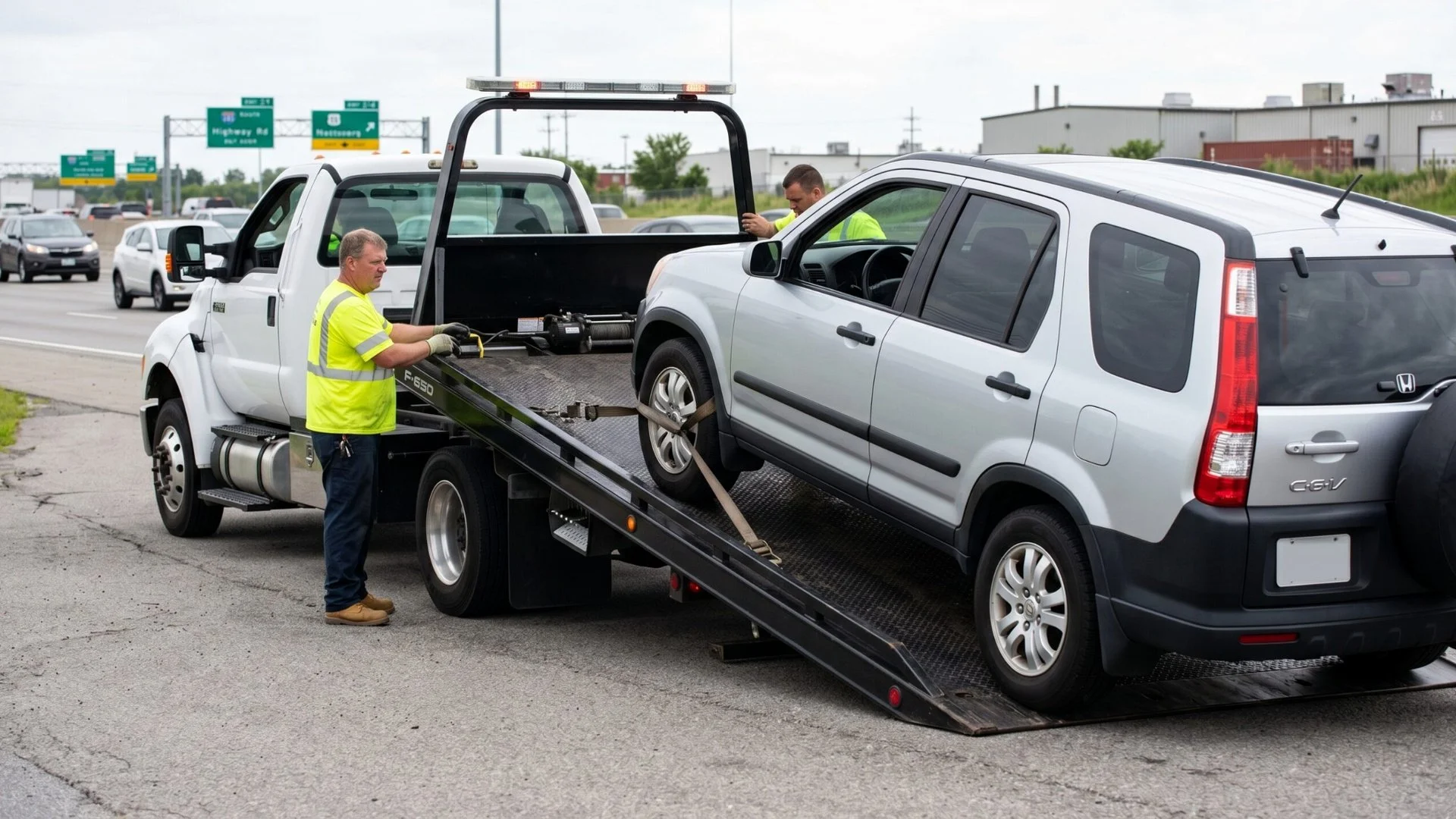
Flatbed towing involves loading the vehicle onto a platform so that all four wheels remain off the road during transportation.
For many automatic-transmission vehicles, this is a preferred option because the road wheels do not rotate during transport. It can be particularly useful for AWD vehicles, cars with transmission problems, and vehicles that cannot be shifted into Neutral.
Benefits include:
Keeps all four wheels off the road during transport.
Reduces the risk associated with rotating driven wheels.
Can accommodate many cars, SUVs, and other compatible vehicles.
Helps transport vehicles that cannot be driven under their own power.
Flatbed towing still requires proper loading, securement, weight limits, and suitable equipment. Low-clearance vehicles, damaged suspension components, and vehicles with locked wheels may need special loading procedures.
Wheel-Lift Towing
A light-duty towing wheel-lift truck raises one axle while the remaining wheels stay on the road. This method can be suitable for some vehicles when the correct axle is lifted and the manufacturer's instructions permit the arrangement.
For example, certain front-wheel-drive vehicles may be transported with their front wheels raised, provided the vehicle's design and towing requirements allow it.
However, the same setup may be unsuitable for an AWD vehicle or a rear-wheel-drive vehicle with an incompatible transmission configuration.
A professional should confirm the correct procedure rather than relying on the vehicle's appearance or drivetrain label alone.
Flat Towing With All Four Wheels on the Ground
Flat towing, sometimes called dinghy towing, involves pulling a vehicle with all four wheels rolling on the road behind another vehicle.
Some vehicles are specifically designed or approved for this arrangement, often under defined speed, distance, and setup restrictions. Others must never be towed this way.
The owner's manual may specify requirements involving the transmission, transfer case, ignition mode, steering, battery, or other systems. If those requirements cannot be met, another transportation method is needed.
Never treat flat towing as a universal option for automatic cars.
Tow Dolly Transportation
A tow dolly lifts two wheels while the other two remain on the road. Whether this method is appropriate depends on the vehicle's drivetrain and manufacturer-approved towing procedure.
Some front-wheel-drive vehicles can be transported on a dolly when positioned correctly. Many AWD vehicles and some other configurations require all wheels to be off the ground.
A dolly is not automatically safer than wheel-lift towing simply because it raises an axle. The vehicle's specific requirements determine whether it is suitable.
What to Do Before Your Automatic Vehicle Is Towed
A few practical steps can help protect your vehicle and make roadside assistance more effective.
Step 1: Move to a Safe Location if Possible
If the vehicle is still controllable, move it away from moving traffic when it is safe to do so. Turn on the hazard lights and follow local roadside safety guidance.
Do not continue driving if the transmission is making unusual noises, the vehicle has lost drive power, or warning signs suggest a serious mechanical problem.
If the car is stopped in a dangerous location, prioritize personal safety and contact appropriate emergency towing or emergency services.
Step 2: Tell the Towing Provider About the Vehicle
Share the following details when requesting assistance:
Vehicle make, model, and model year.
Whether it has an automatic transmission.
Whether it is front-wheel drive, rear-wheel drive, AWD, or 4WD.
Whether the engine starts and the vehicle can shift into Neutral.
Any transmission, suspension, steering, or accident damage.
These details help the towing operator determine which equipment and loading procedure may be suitable.
Step 3: Check the Owner's Manual
Look for the emergency towing or vehicle transportation section. Manufacturers may provide specific instructions for wheel position, maximum speed, towing distance, transmission settings, and other precautions.
If the manual is unavailable, a manufacturer's official online manual or dealer service department may help confirm the requirements.
Do not guess at the procedure when the vehicle's towing restrictions are unclear.
Step 4: Explain Any Mechanical Problems
Tell the operator if the vehicle has a locked transmission, damaged wheels, a parking brake that will not release, or an engine that will not start.
An automatic vehicle that cannot shift into Neutral may require skates, dollies, a winch, or specialized loading equipment. Forcing the gear selector or dragging locked wheels can cause additional damage.
Step 5: Confirm the Towing Method Before Loading
Ask how the vehicle will be transported and whether that method is compatible with its drivetrain.
A professional should consider the manufacturer's instructions, the vehicle's condition, and the available equipment before proceeding.
Clear communication is particularly valuable after an accident, when damage may not be visible or the vehicle's mechanical condition may be uncertain.
Common Misconceptions About Towing Automatic Vehicles
Several widely repeated assumptions can lead to expensive mistakes.
Misconception 1: Neutral Makes Every Car Safe to Tow
Neutral does not guarantee that the transmission's internal components will receive the lubrication they need while the wheels rotate.
The correct approach: Follow the manufacturer's approved towing procedure, including any restrictions on speed and distance.
Misconception 2: A Short Distance Cannot Cause Damage
There is no universal distance that makes an otherwise prohibited towing method safe. The risk depends on the transmission design and the conditions under which the vehicle is moved.
The correct approach: Choose an approved method before the vehicle begins moving.
Misconception 3: Turning the Ignition On Solves the Problem
Switching the ignition on may allow the steering to operate or enable certain vehicle systems, but it does not necessarily provide transmission lubrication.
Some modern vehicles also have electronic gear selectors that behave differently when the engine is off or the battery is depleted.
The correct approach: Follow the vehicle-specific instructions rather than assuming that ignition settings make towing safe.
Misconception 4: Every Automatic Vehicle Needs a Flatbed
A flatbed is a suitable choice for many vehicles, but some automatic vehicles permit other towing methods under specified conditions.
The correct approach: Use the method approved for the particular vehicle. When restrictions are unclear or mechanical damage is suspected, a flatbed may be the more conservative option if it can safely accommodate the vehicle.
Misconception 5: Towing Damage Always Appears Immediately
Some damage may produce immediate warning signs, while other problems may become apparent later. The absence of an obvious symptom does not prove that an improper tow caused no harm.
The correct approach: If the vehicle was transported incorrectly, explain what happened to a qualified mechanic and seek advice about inspection before continued use.
Special Considerations for Modern Vehicles
Modern automatic vehicles may have electronic systems that complicate roadside recovery. These systems can affect how the vehicle is shifted, released, loaded, and secured.
Electronic Gear Selectors and Dead Batteries
Some vehicles use electronic gear selectors rather than traditional mechanical shifters. A dead battery can prevent the vehicle from entering Neutral through the normal controls.
Certain models provide a manual shift-lock release or a manufacturer-defined recovery procedure. Others require specialized equipment.
Do not force the selector or attempt an unfamiliar override. An operator should consult the vehicle's instructions before moving it.
Hybrid and Electric Vehicles
Hybrid and electric vehicles may use reduction gears, electric drive motors, and other drivetrain arrangements that differ from conventional automatic transmissions.
Their towing restrictions can be particularly important because rotating the wheels may affect the drive system even when the vehicle is switched off. Some models require flatbed transportation, while others permit limited movement under specific conditions.
If you drive a hybrid or electric vehicle, tell the towing provider before assistance arrives.
Vehicles Damaged in Accidents
After a collision, transmission and drivetrain damage may not be visible. Bent suspension parts, damaged axles, leaking fluids, or misaligned wheels can make ordinary towing procedures unsuitable.
A vehicle with extensive damage may need winching or specialized vehicle recovery equipment before it can be loaded safely.
Do not attempt to drive a damaged vehicle merely to make loading easier. Let a qualified operator assess the safest approach.
How Weather and Road Conditions Affect Towing Decisions
Roadside emergencies in Louisiana can occur during heavy rain, on wet highways, or along roads with limited shoulders. These conditions affect recovery safety as well as the towing method.
Heavy Rain and Flooded Roads
Wet pavement can reduce traction for towing equipment and increase the danger of roadside work. Floodwater can also conceal road damage and create hazards for both vehicles and operators.
Never drive a disabled vehicle through floodwater to reach a more convenient pickup point. If water is rising or the location is dangerous, move to a safe place if possible and contact emergency services when necessary.
Soft Shoulders and Vehicles Stuck Off the Road
A car that slides into a ditch or soft shoulder may need vehicle recovery before transportation can begin. Pulling it out at the wrong angle can damage suspension parts, bumpers, or drivetrain components.
A trained operator can assess the recovery position, ground conditions, and suitable attachment points. Once the vehicle is recovered, its transmission and drivetrain requirements still determine how it should be transported.
Choosing Roadside Assistance for an Automatic Transmission Vehicle
When a vehicle breaks down, drivers may be focused on reaching a repair shop quickly. However, the right towing provider should also understand how to protect the vehicle during loading and transportation.
Look for a provider that asks about the vehicle's drivetrain, mechanical condition, and location. These questions help determine whether a flatbed, wheel-lift truck, dolly, or specialized recovery equipment is appropriate.
Before transportation begins, communicate any unusual symptoms and ask the operator to confirm that the planned method follows the vehicle's towing requirements.
Drivers in Marrero, Harvey, Gretna, Westwego, and surrounding Louisiana communities may encounter automatic-transmission problems caused by breakdowns, collisions, or other roadside emergencies. A local towing and roadside assistance provider such as A&Z Towing LLC can help arrange transportation based on the vehicle's condition and recovery needs.
The most useful preparation happens before a breakdown. Knowing your vehicle's drivetrain, keeping the owner's manual accessible, and understanding basic towing restrictions can help you make a more informed decision when assistance is needed.
Conclusion
Towing a vehicle with an automatic transmission requires more than attaching a tow line and moving the car to a repair shop. Depending on the vehicle's design, improper towing can lead to transmission overheating, internal component wear, drivetrain damage, and avoidable repair expenses.
The safest towing method depends on the manufacturer's instructions, drivetrain configuration, mechanical condition, and available equipment. Flatbed towing is often a practical option because it keeps all four wheels off the road, but it is not the only approved method for every vehicle.
Remember these essential precautions: do not assume Neutral makes towing safe, check the owner's manual, disclose mechanical problems, and confirm the towing method before the vehicle is moved. If your vehicle cannot shift into Neutral, has sustained accident damage, or has an unknown towing restriction, professional assessment is especially valuable.
Taking these steps can help protect your vehicle and reduce the chance that a roadside breakdown becomes a more expensive mechanical problem.
Frequently Asked Questions
1. Can towing damage an automatic transmission?
Yes. Towing can damage an automatic transmission if the vehicle's driven wheels rotate without the lubrication or cooling required by its design. The risk depends on the transmission type, towing method, speed, distance, and manufacturer instructions.
2. Is it safe to tow an automatic car in Neutral?
Not always. Neutral does not guarantee adequate transmission lubrication when the wheels rotate. Check the owner's manual for approved towing methods and restrictions before moving the vehicle.
3. Is flatbed towing better for automatic transmission vehicles?
Flatbed towing is often a suitable choice because it keeps all four wheels off the road during transportation. It can reduce risks associated with rotating driven wheels, particularly for many AWD vehicles and vehicles with suspected transmission damage.
4. Can an automatic car be towed with its front wheels on the ground?
It depends on the vehicle's drivetrain and transmission design. Some vehicles permit this arrangement under specific conditions, while others prohibit it. Always verify the manufacturer's towing instructions before proceeding.
5. How far can you tow an automatic car without damaging the transmission?
There is no universal safe towing distance. Some vehicles prohibit certain towing methods entirely, while others allow limited movement subject to speed and distance restrictions. Follow the vehicle-specific instructions.
6. Can an AWD automatic vehicle be towed with two wheels on the ground?
Many AWD vehicles require all four wheels to be off the ground during transportation, although requirements vary by model. Using an unsuitable method can damage drivetrain components. Consult the owner's manual before towing.
7. What should I do if my automatic car will not shift into Neutral?
Do not force the gear selector or drag the vehicle with locked wheels. Inform the towing provider about the problem so the operator can determine whether a shift-lock release, wheel skates, dollies, or specialized loading equipment is needed.
8. How can I tell if my transmission was damaged during towing?
Possible warning signs include unusual noises, delayed gear engagement, slipping, harsh shifting, fluid leaks, or transmission warning lights. These symptoms can have several causes, so arrange a professional inspection if damage is suspected.
9. Can a vehicle with transmission problems be transported on a flatbed?
In many cases, yes. A flatbed towing setup can keep the vehicle's wheels from rotating during transportation, which may help reduce drivetrain risks. However, locked wheels, suspension damage, low ground clearance, or other complications may require specialized loading procedures.
10. Should I tell the towing company that my car has an automatic transmission?
Yes. Provide the vehicle's make, model, year, drivetrain, and any known mechanical problems. This information helps the operator select appropriate equipment and follow the manufacturer's transportation requirements.
