What Should You Do If Your Vehicle Gets Stuck in Mud or Soft Ground?
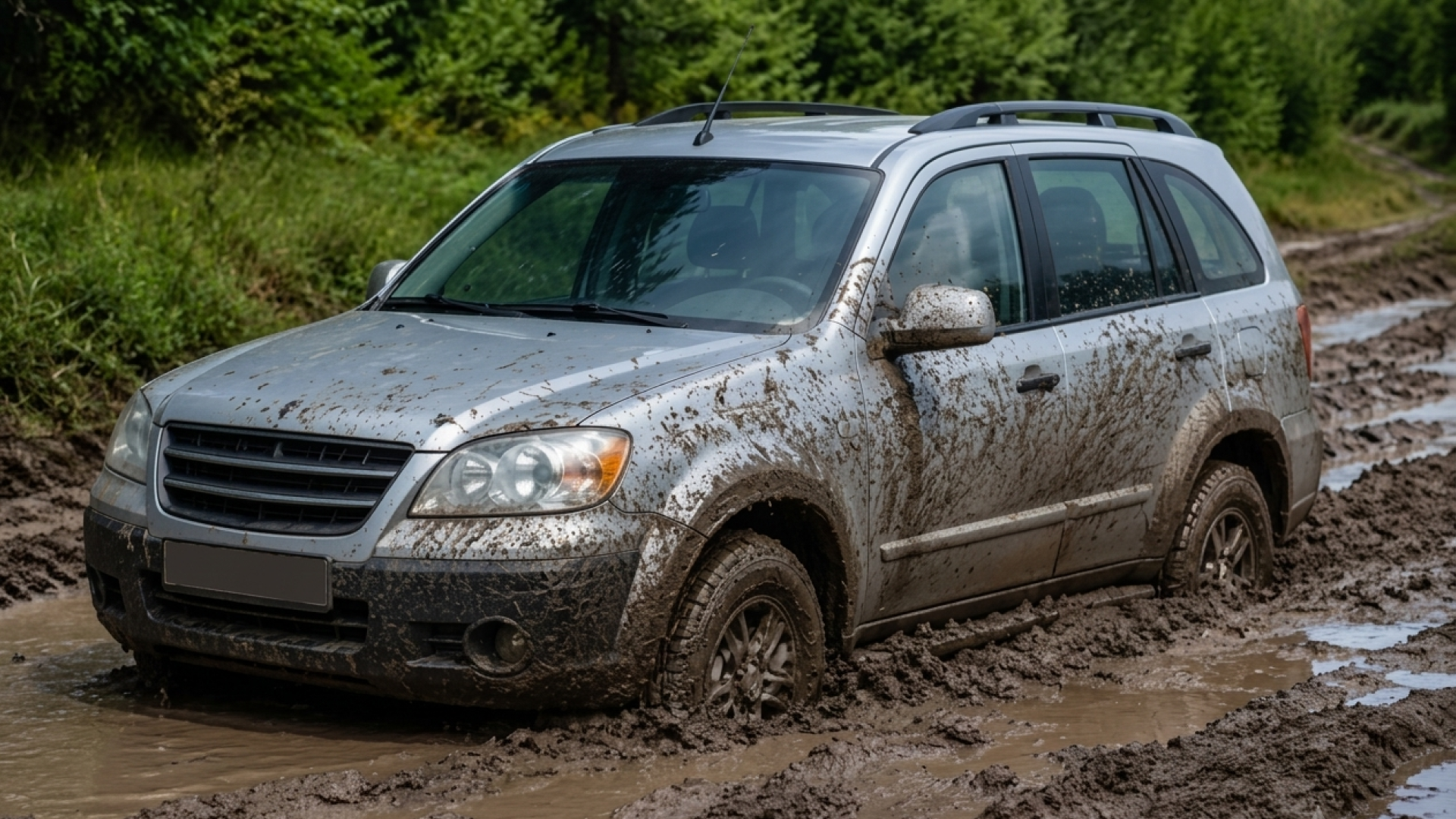
Getting a vehicle stuck in mud or soft ground can happen in seconds. You may pull onto a muddy shoulder, drive across a wet parking area, take a dirt road after heavy rain, or accidentally leave the pavement while trying to avoid an obstacle. Once the tires begin spinning, getting back onto firm ground can become much harder than expected.
The first thing to remember is simple: do not keep spinning the tires and hope the vehicle will eventually break free. Wheelspin can dig the tires deeper into the ground, reduce traction, and make recovery more difficult.
A safer approach is to stop, assess the situation, improve traction if possible, and attempt only a controlled recovery. If the vehicle is deeply stuck, sitting at an unsafe angle, or cannot be moved without excessive force, professional vehicle recovery may be the safest option.
This guide explains what to do when a car, SUV, or light-duty vehicle gets stuck in mud or soft ground, how to recognize when a recovery attempt is becoming unsafe, and what information to provide when calling for roadside assistance or towing.
Why Vehicles Get Stuck in Mud or Soft Ground
Mud creates a difficult combination of low traction and unstable ground. Your tires need enough grip against the surface to move the vehicle, but wet soil can prevent the tread from developing that grip.
As the wheels rotate, they may push mud away from the tire instead of moving the vehicle forward. The tires can gradually sink, leaving the vehicle sitting lower than it was when it first became stuck.
How Tire Spin Makes the Problem Worse
If you press the accelerator aggressively, the drive wheels may spin faster than the vehicle moves. Instead of climbing out of the soft area, the tires can excavate the ground underneath themselves.
This can create deeper ruts around the tires. Once the vehicle's underside begins resting on mud, traction becomes even harder to establish.
A vehicle that initially needed only a small amount of assistance may eventually require a more involved recovery.
Why Vehicle Weight Matters
A heavier vehicle places more pressure on the ground beneath its tires. On firm pavement, that weight is not usually a problem because the surface supports the vehicle. Soft soil is different.
If the ground cannot support the vehicle's weight, the tires can sink. Ground clearance, tire type, drivetrain, and the depth of the mud can all affect how difficult the winch out services become.
What Should You Do First If Your Vehicle Is Stuck?
The safest first step is to stop spinning the wheels and evaluate the situation.
Before attempting to move, consider where the vehicle is positioned, how deep the tires have sunk, whether the vehicle is level, and whether there is a safe path back to solid ground.
1. Stop and Assess the Situation
Take your foot off the accelerator and let the wheels stop turning. Look around the vehicle if it is safe to exit.
Check:
Which tires are stuck
How deeply the tires are buried
Whether the vehicle is resting on its undercarriage
Whether mud is packed around the tires
Whether there is firm ground nearby
Whether the vehicle is close to traffic, water, a ditch, or another hazard
If the vehicle is in an active traffic lane or another dangerous location, prioritize your personal safety rather than attempting a recovery.
2. Check Your Surroundings Before Exiting
Getting out of a stuck vehicle can create another hazard. Soft shoulders may be unstable, and muddy areas can conceal holes, drainage channels, rocks, or debris.
If you are near moving traffic, stay aware of passing vehicles and avoid standing where you could be struck.
If remaining inside the vehicle is safer because of traffic or environmental conditions, call for emergency towing rather than attempting to inspect the vehicle yourself.
3. Clear Mud From Around the Tires
If the vehicle is in a safe location and you can work around it without putting yourself at risk, remove loose mud from immediately around the drive tires.
A shovel or similar tool can help create a clearer path in front of or behind the tires.
The goal is not to dig an enormous hole. The objective is to give the tires a reasonable path toward firmer ground.
How Can You Get a Vehicle Out of Mud?
A lightly stuck vehicle may sometimes be freed with a controlled traction attempt. The exact method depends on the vehicle, terrain, and depth of the mud.
Reduce Wheelspin
Use gentle accelerator input rather than flooring the gas pedal. Excessive wheelspin usually removes material beneath the tire instead of creating forward movement.
If the vehicle has a traction-control, snow, mud, sand, or similar drive mode, check the owner's manual to determine which setting is appropriate for the conditions.
Different vehicles use different systems, so there is no universal setting that should be used for every situation.
Straighten the Steering
If possible, keep the front wheels relatively straight while attempting to move out.
Turning the steering wheel sharply can increase resistance and make it harder for the vehicle to follow a straight path onto firm ground.
A straight, gradual path is often easier to manage than trying to make a tight turn while the tires are already struggling for traction.
Try Gentle Forward-and-Backward Movement
If there is enough room and the vehicle is only lightly stuck, controlled movement between reverse and forward may sometimes help the tires climb out of shallow ruts.
The movement should be gradual. Do not repeatedly slam between gears or use aggressive acceleration.
If the vehicle does not respond after a few controlled attempts, stop. Continuing can turn a relatively simple situation into a deeper recovery problem.
Can Traction Aids Help?
Traction aids can sometimes provide the additional grip needed to get tires out of shallow mud.
Depending on the circumstances, drivers may use commercially designed traction boards or other appropriate recovery equipment. In some situations, suitable material placed beneath the drive tires can improve the surface under the tread.
Use Traction Equipment Carefully
Anything placed under a tire can be thrown out when the wheel spins. Keep people clear of the tire path and never position yourself directly in front of or behind a spinning wheel.
The vehicle should also have a reasonable route toward firm ground. Adding traction material will not solve a situation where the vehicle is deeply buried or resting on its underside.
Avoid Improvised Recovery Methods
A common mistake is attaching a rope, chain, or strap to whatever part of the vehicle looks strong.
That can cause serious damage. Recovery equipment should be attached only to a manufacturer-approved recovery point or another properly rated attachment point specified for the vehicle and equipment being used.
A tow hitch receiver, suspension component, bumper support, and recovery point are not automatically interchangeable.
When Should You Stop Trying to Free the Vehicle Yourself?
Knowing when to stop is just as important as knowing what to try.
A vehicle recovery attempt should end when the situation requires force, equipment, or positioning that you cannot safely control.
Stop If the Tires Keep Digging Deeper
If every attempt leaves the tires deeper in the mud, continuing to accelerate is unlikely to solve the problem.
At that stage, the vehicle may need professional recovery equipment rather than additional throttle.
Stop If the Vehicle Is Resting on Its Undercarriage
If the frame, exhaust, differential, transmission components, or another part of the underside is sitting on the ground, the tires may no longer be able to generate enough traction.
Trying to drive out aggressively can potentially damage components underneath the vehicle.
Stop If the Vehicle Is Near a Dangerous Drop or Ditch
A vehicle positioned close to a ditch, embankment, water, or unstable shoulder requires extra caution.
A sudden movement could change the vehicle's position or make the recovery more complicated.
Professional vehicle recovery is particularly useful when controlled pulling or specialized equipment is required.
What Is Professional Vehicle Recovery?
Vehicle recovery is different from an ordinary tow.
A standard tow generally involves moving a vehicle from one accessible location to another. Vehicle recovery focuses on safely extracting a vehicle that is stuck, disabled, immobilized, or positioned somewhere that makes a normal tow difficult.
Recovery situations can involve mud, soft ground, ditches, uneven terrain, collisions, or vehicles that cannot simply be driven onto a tow truck.
Equipment Used for Vehicle Recovery
Depending on the situation, professional operators may use equipment such as:
Winches
Recovery straps
Chains rated for appropriate recovery applications
Tow trucks
Wheel-lift equipment
Specialized recovery attachments
Traction equipment
The equipment used should match the vehicle, terrain, recovery point, and circumstances.
Why Recovery Requires More Than Just a Tow Truck
Pulling a stuck vehicle is not simply a matter of applying more force.
The operator needs to consider the direction of the pull, the vehicle's position, the stability of the ground, the attachment points, surrounding obstacles, and the possibility of vehicle movement during recovery.
That is why professional recovery is preferable when a vehicle is deeply stuck or cannot be moved safely under its own power.
Standard Towing vs. Vehicle Recovery
The two services are related but serve different situations.
Vehicle is on firm pavement: Usually appropriate for standard towing; usually unnecessary for recovery.
Vehicle is disabled but accessible: Often appropriate for standard towing; may not be needed for recovery.
Vehicle is stuck in deep mud: May require recovery equipment; often more appropriate for recovery services.
Vehicle is partially in a ditch: May require specialized handling; recovery may be required.
Vehicle is resting on uneven terrain: Depends on accessibility; may require recovery planning.
Vehicle needs controlled extraction: Not always sufficient with standard towing; designed for this type of situation with recovery services.
The key difference is access and extraction. A vehicle sitting safely on pavement can often be loaded or connected for towing. A vehicle buried in mud may need to be extracted before it can be transported.
What Should You Tell a Towing or Recovery Company?
When requesting roadside assistance, provide as much useful information as possible.
Tell the operator:
Your exact location or nearest recognizable landmark.
The type of vehicle you are driving.
Whether the vehicle is stuck in mud, soft soil, sand, or another surface.
How deeply the tires are stuck.
Whether the vehicle is resting on its underside.
Whether the vehicle is in a ditch or near an incline.
Whether you are blocking traffic.
Whether the vehicle can move at all.
Whether there are visible obstacles around the vehicle.
Whether anyone is injured or there is an immediate safety concern.
Photos can also be useful if it is safe to take them. A clear picture of the vehicle and surrounding terrain can help a recovery provider understand what equipment may be needed.
What Should You Avoid When Your Vehicle Is Stuck?
Some recovery attempts create more problems than they solve.
Do Not Keep Flooring the Accelerator: High wheel speed can dig the tires deeper and create larger ruts.
Do Not Attach a Strap to an Unknown Vehicle Component: An attachment point that looks strong may not be designed to withstand recovery forces.
Do Not Stand Near a Loaded Recovery Strap or Cable: Recovery equipment can store significant energy under tension. People should remain outside the potential movement path of the vehicle and recovery equipment.
Do Not Let Multiple People Push a Vehicle in an Unsafe Location: A vehicle can move suddenly once traction is restored. If people are standing close to the vehicle, that movement can create a serious hazard.
Do Not Ignore Warning Signs of Vehicle Damage: If you smell burning, hear unusual noises, see leaking fluids, or notice damage underneath the vehicle, stop attempting to drive it. Getting the vehicle out of the mud is only part of the problem. It also needs to be safe to operate afterward.
What If Your Vehicle Gets Stuck on a Louisiana Roadside?
Louisiana drivers can encounter soft shoulders, muddy areas, drainage ditches, wet ground, and other surfaces that become difficult to cross after rain.
A vehicle that leaves the paved roadway can quickly lose traction, particularly when the shoulder is saturated.
If your vehicle becomes stuck near Marrero, Harvey, Gretna, Westwego, or another surrounding Louisiana area, first make sure you and your passengers are in a safe position. If the vehicle cannot be freed without aggressive wheelspin or specialized equipment, contact a towing and vehicle recovery provider.
A&Z Towing LLC provides 24/7 towing and roadside assistance for drivers in Marrero and surrounding areas, including vehicle recovery for situations where a vehicle cannot simply be driven away. Visit our about page to learn more about our local services, or contact us directly for immediate dispatch.
How to Prevent Getting Stuck in Soft Ground
Prevention starts with recognizing surfaces that may not support the vehicle.
Be cautious around:
Muddy shoulders
Unpaved areas after heavy rain
Waterlogged parking areas
Deep ruts
Soft grass
Construction areas
Unmaintained dirt roads
Areas near drainage ditches
If a surface looks questionable, avoid driving onto it unless you know it can support your vehicle.
It is also useful to keep basic roadside equipment in your vehicle, including a flashlight, gloves, reflective safety equipment, and other items appropriate for your driving conditions.
Pay Attention to Changing Ground Conditions
A route that was firm earlier in the day can become soft after significant rainfall. Likewise, a seemingly solid shoulder may have a soft layer underneath.
If you are unsure whether a surface is safe, staying on firm pavement is generally the safer choice.
Common Misconceptions About Getting Unstuck
Several common assumptions can lead drivers to make the situation worse.
"More Gas Will Get Me Out": Not necessarily. More acceleration can simply make the drive tires spin faster and dig deeper.
"Any Tow Strap Will Work": Recovery equipment must be appropriate for the situation and attached correctly. Using unsuitable equipment or an incorrect attachment point can cause equipment failure or vehicle damage.
"If the Vehicle Can Still Move, I Don't Need Recovery": A vehicle may move slightly while still being too deeply stuck to drive out safely. Repeated attempts can worsen the terrain and increase the difficulty of extraction.
"A Regular Tow Is the Same as a Recovery": Not always. A normal tow and a vehicle recovery can require different equipment and techniques depending on where and how the vehicle is stuck.
A Simple Step-by-Step Recovery Checklist
If your vehicle becomes stuck in mud or soft ground, use this basic checklist:
Stop accelerating.
Assess your surroundings and personal safety.
Check how deeply the tires are stuck.
Determine whether there is a safe route toward firm ground.
Clear loose material around the drive tires if it is safe to do so.
Use appropriate traction equipment if available.
Try only gentle, controlled movement.
Stop if the tires dig deeper or the vehicle does not respond.
Avoid unsafe pulling methods or improvised attachment points.
Call a professional recovery service if specialized equipment is needed.
The objective is not simply to make the vehicle move. The objective is to recover it without creating additional damage or putting people in danger.
Conclusion
Getting stuck in mud or soft ground can turn a routine drive into a roadside emergency surprisingly quickly. The most useful first step is usually to stop spinning the tires and assess the situation rather than applying more throttle.
If the vehicle is only lightly stuck, clearing mud, improving traction, and making a controlled attempt toward firm ground may help. If the tires continue digging, the vehicle is resting on its underside, or the vehicle is positioned in a ditch or another hazardous area, continuing to experiment can make recovery more difficult.
Professional vehicle recovery is designed for situations where a normal tow or self-recovery attempt is not enough. For drivers in Marrero, Harvey, Gretna, Westwego, and surrounding Louisiana areas, A&Z Towing LLC provides 24/7 towing, roadside assistance, and vehicle recovery support when a vehicle cannot safely get back onto the road under its own power.
The safest recovery is the one that gets the vehicle out without turning a minor traction problem into vehicle damage or a personal safety emergency.
Frequently Asked Questions
Can a car be damaged by driving through mud?
Yes. Mud itself does not automatically damage a vehicle, but deep mud, hidden obstacles, excessive wheelspin, and contact with the vehicle's underside can cause problems. After getting stuck, check for visible damage, unusual noises, fluid leaks, or warning lights before continuing to drive.
Should I keep accelerating if my tires are spinning in mud?
No. Continued wheelspin can dig the tires deeper and reduce your chances of getting out. Release the accelerator, assess the situation, and consider whether traction can be improved safely. If the vehicle remains stuck, professional recovery may be appropriate.
Can roadside assistance help with a vehicle stuck in mud?
Yes, depending on the provider and the circumstances. A roadside assistance or towing company may be able to arrange vehicle recovery using appropriate equipment. When calling, explain that the vehicle is stuck in mud or soft ground rather than simply saying that it needs a tow.
What information should I provide when requesting vehicle recovery?
Give the recovery provider your exact location, vehicle type, ground conditions, depth of the mud, vehicle position, and whether the vehicle is in a ditch or near traffic. Explain whether the vehicle can move at all and mention any visible damage or obstacles.
Is vehicle recovery different from regular towing?
Yes. Regular towing generally involves transporting an accessible vehicle, while recovery involves extracting a vehicle that is stuck, off the roadway, in soft ground, in a ditch, or otherwise difficult to access. Recovery may require specialized equipment and controlled pulling techniques.
Can I use a tow strap to pull my car out of mud?
A properly rated recovery strap may be used in appropriate circumstances, but it must be attached to a manufacturer-approved recovery point or another correctly rated point. Do not attach recovery equipment to suspension parts, bumpers, or other components unless the vehicle manufacturer specifically identifies them for that purpose.
What should I do if my vehicle is stuck near traffic?
Personal safety should come first. Turn on your hazard lights when appropriate, stay alert to approaching vehicles, and avoid standing in an exposed traffic area. If the vehicle cannot be safely moved, contact roadside assistance or emergency services when an immediate traffic hazard exists.
Can a flatbed tow truck recover a vehicle stuck in mud?
A flatbed can transport a recovered vehicle, but whether it can directly handle a vehicle stuck in mud depends on the vehicle's position and accessibility. A recovery process may be necessary before the vehicle can be loaded onto the flatbed.
Can a vehicle get stuck even if it has four-wheel drive?
Yes. Four-wheel drive or all-wheel drive can improve traction in many conditions, but it does not make a vehicle immune to soft ground. Tire condition, ground depth, vehicle weight, clearance, and the terrain can all affect whether the vehicle becomes stuck.
How can I avoid getting stuck in soft ground?
Avoid driving onto visibly muddy shoulders, waterlogged areas, deep ruts, and questionable unpaved surfaces, especially after heavy rain. If you are uncertain whether the ground can support your vehicle, staying on a firm surface is generally safer than testing it with the vehicle.