

How Professional Tow Operators Transport All-Wheel-Drive Vehicles Safely
Introduction
An all-wheel-drive (AWD) vehicle can provide better traction on wet roads, loose gravel, and slippery surfaces, but its drivetrain also requires special attention when the vehicle needs towing. Unlike some two-wheel-drive vehicles, an AWD car or SUV may not tolerate having only one axle rolling on the road while the other remains stationary. Depending on the drivetrain design, this can cause damage to internal components, even when the vehicle appears to be moving normally.
Professional tow operators understand that transporting an AWD vehicle safely involves more than connecting a tow truck and pulling the vehicle away. They must identify the vehicle, determine its drivetrain requirements, select the appropriate towing equipment, and secure it correctly before transport begins.
These precautions matter during roadside breakdowns, collisions, battery failures, and other emergencies. A vehicle that cannot move under its own power may still have specific requirements for how its wheels are positioned and supported.
For drivers in Marrero, Harvey, Gretna, Westwego, and surrounding Louisiana communities, understanding how professional towing works can help prevent avoidable vehicle damage. It also makes it easier to communicate with a towing provider when requesting assistance.
Why All-Wheel-Drive Vehicles Require Special Towing Procedures
An AWD vehicle distributes engine power to all four wheels, either continuously or when additional traction is needed. The exact method depends on the vehicle's design. Some systems use mechanical components to distribute power between the front and rear axles, while others rely on electronically controlled clutches or other specialized mechanisms.
These differences affect how the vehicle can be moved when it is disabled.
How an AWD Drivetrain Works
The drivetrain transfers power from the engine or electric motor to the wheels. Depending on the design, it may include a transmission, transfer unit, differentials, driveshafts, and electronically controlled components.
When the vehicle is operating normally, these parts work together to manage power delivery. During towing, however, the wheels may rotate while some drivetrain components are not being lubricated or controlled in the same way they would be during normal driving.
The result depends on the specific vehicle. Some AWD systems permit certain towing methods under defined conditions, while others require all four wheels to remain off the ground.
That is why professional operators should consult the manufacturer's towing instructions rather than assume that every AWD vehicle can be transported in the same way.
What Can Happen if an AWD Vehicle Is Towed Incorrectly?
Incorrect towing can place unwanted stress on drivetrain components. Depending on the vehicle and towing method, potential problems include:
Overheating or damage to transmission components.
Excessive wear within differentials or transfer units.
Damage to electronically controlled drivetrain systems.
Tire dragging or uneven wheel movement.
Additional damage to a vehicle that has already been involved in an accident.
Not every incorrect towing method will automatically cause damage, and the risk varies by model. However, avoiding unnecessary drivetrain movement is a sensible precaution when the manufacturer's requirements are unknown.
AWD, 4WD, and Two-Wheel Drive Are Not Interchangeable
Drivers sometimes use all-wheel drive (AWD) and four-wheel drive (4WD) as if they mean exactly the same thing. Although both systems can deliver power to all four wheels, their mechanical designs and operating modes can differ considerably.
A two-wheel-drive vehicle generally sends power to either the front or rear axle. Depending on its design, it may be suitable for certain wheel-lift towing methods when the driven wheels are properly supported.
An AWD vehicle may require all four wheels to be lifted or placed on a suitable transport surface. A 4WD vehicle may have additional requirements involving its transfer case or selectable drive modes.
The vehicle's make, model, drivetrain, and owner's manual determine the correct procedure. Appearance alone is not a reliable guide.
How Professional Tow Operators Choose the Right Equipment
Choosing the correct tow truck is one of the most important steps in safe AWD vehicle transport. Professional operators assess the vehicle's requirements and condition before deciding how to load it.
The goal is to move the vehicle without creating unnecessary stress on its drivetrain, tires, suspension, or bodywork.
Flatbed Tow Trucks: A Common Choice for AWD Vehicles
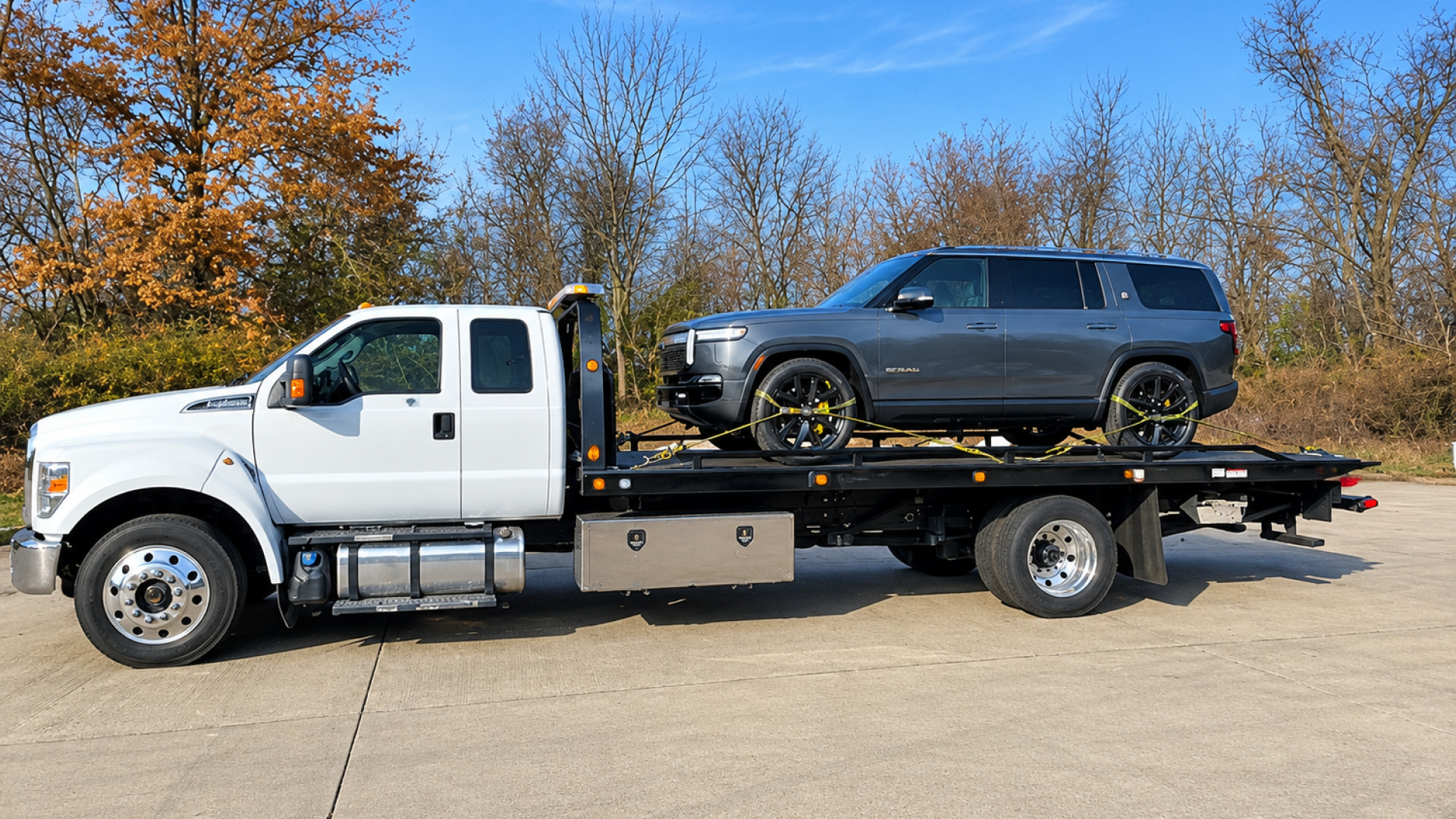
A flatbed tow truck has a platform that can be lowered to ground level or positioned at an angle to load a vehicle. Once the car is secured, the platform carries the vehicle rather than requiring its tires to roll along the road.
This makes flatbed towing a common choice for AWD cars and SUVs, especially when the manufacturer requires all four wheels to be off the ground.
A flatbed tow truck can also be useful when:
The vehicle has a transmission or drivetrain problem.
The car has sustained collision damage.
The vehicle cannot be driven safely.
The operator cannot confirm whether conventional towing is permitted.
The vehicle needs to travel a longer distance without its tires rolling on the roadway.
A flatbed is not automatically appropriate for every situation. The truck must have sufficient capacity, the loading approach must be safe, and the operator must account for the vehicle's condition and ground clearance.
Wheel-Lift Towing and Its Limitations
Wheel-lift towing uses a lifting mechanism to support one end of a vehicle while the other end remains on the road. It can be effective for many towing situations, but AWD vehicles require particular caution.
If one axle remains on the ground while the other is raised, the wheels may rotate at different rates or under conditions the drivetrain was not designed to tolerate.
Some vehicles permit particular wheel-lift procedures when the remaining wheels are supported by approved dollies or other equipment. Others require a different method altogether.
A professional operator should never assume that lifting the front wheels or rear wheels is safe simply because the vehicle is not moving under engine power.
Tow Dollies and Auxiliary Equipment
A tow dolly supports one pair of wheels while the other pair may remain on the road. For certain vehicles, this arrangement is acceptable when the manufacturer's instructions specifically permit it.
For AWD vehicles, however, a standard dolly setup may not provide the required protection. An operator must determine whether all four wheels need to be elevated or whether another approved configuration is allowed.
Auxiliary equipment may also be necessary when a vehicle has locked wheels, damaged tires, limited ground clearance, or collision-related suspension problems.
The equipment should match both the vehicle's towing requirements and the conditions at the recovery location.
Step-by-Step: How Professionals Transport an AWD Vehicle Safely
Safe towing begins before the vehicle is loaded. A careful process helps operators identify potential hazards and reduce the chance of additional damage.
Step 1: Identify the Vehicle and Its Drivetrain
The operator begins by confirming the vehicle's make, model, year, and drivetrain configuration. Badges such as AWD or 4WD can provide clues, but they may not tell the complete story.
The operator may consult the owner's manual, manufacturer guidance, or other reliable vehicle-specific information to confirm the correct towing method.
This step is particularly important when the vehicle has an unfamiliar drivetrain or when a hybrid or electric powertrain introduces additional transport requirements.
Step 2: Assess the Vehicle's Condition
Before moving the vehicle, the operator evaluates why it needs assistance and whether it can be loaded normally.
Relevant questions include:
Does the vehicle start or move?
Are any wheels locked or unable to rotate?
Has the vehicle suffered collision damage?
Are the tires, steering, or suspension damaged?
Is the vehicle parked on a slope or in a confined area?
Are there fluid leaks, smoke, or other immediate hazards?
A car with a failed transmission may require a different loading approach from an AWD SUV with a flat tire. Collision damage can also make ordinary loading procedures unsafe.
Step 3: Select the Appropriate Tow Truck
After assessing the vehicle, the operator chooses equipment that satisfies its towing requirements.
For many AWD vehicles, this means using a flatbed capable of carrying the entire vehicle. The operator also checks the truck's rated capacity and whether the vehicle's dimensions, weight, and ground clearance are compatible with the equipment.
If the vehicle cannot roll freely, additional recovery equipment may be needed to position it without dragging damaged components.
Selecting suitable equipment before loading reduces the need for risky adjustments at the roadside.
Step 4: Prepare the Loading Area
Loading should take place on a stable surface whenever possible. The operator considers traffic, visibility, road conditions, the vehicle's position, and the available space.
On a busy road, the priority is to establish a safe working area and protect everyone nearby. Warning lights and other appropriate safety measures can help make the operation more visible to approaching drivers.
Louisiana's rain, standing water, and wet pavement can complicate roadside recovery. Operators must account for reduced traction and the possibility that a disabled vehicle may shift during loading.
Step 5: Load the Vehicle Carefully
For flatbed towing, the operator positions the platform and uses the appropriate loading method to bring the vehicle onto it. A vehicle that rolls normally may be winched or driven onto the bed when the manufacturer's instructions and its condition permit.
If the drivetrain, brakes, steering, or wheels are damaged, the operator may need specialized loading procedures or additional equipment.
The vehicle should not be dragged carelessly across the ground. Doing so can damage tires, underbody components, bumpers, or suspension parts.
Low-clearance vehicles also require attention to the loading angle. Proper positioning helps reduce the risk of scraping the front bumper, exhaust components, or undercarriage.
Step 6: Secure the Vehicle Correctly
Once the vehicle is on the platform, the operator secures it using suitable tie-down equipment and approved attachment points.
The restraint method must be appropriate for the vehicle and the towing equipment. Operators should avoid attaching straps or chains to components that are not designed to withstand those forces.
Proper securement helps prevent the vehicle from shifting during braking, cornering, or travel over uneven roads.
The operator also checks that the vehicle is positioned within the truck's rated load limits and that the restraints are properly installed.
Step 7: Perform a Final Safety Check
Before departure, the operator verifies that the vehicle is secure and that the towing equipment is ready for transport.
The check may include confirming strap placement, inspecting loading equipment, verifying platform locks, and making sure no loose components create a hazard.
If the vehicle has significant collision damage or unusual movement, the operator should reassess the setup before proceeding.
Step 8: Transport the Vehicle to the Appropriate Destination
Once the vehicle is secured, the operator transports it to the requested repair facility, residence, or other suitable destination.
Driving conditions, route selection, traffic, and the vehicle's position on the truck all matter. The driver must operate the tow truck within its rated capacity and follow applicable road safety requirements.
The process does not end when the vehicle reaches its destination. Unloading also requires care, particularly if the vehicle has locked wheels, damaged steering, or a low-clearance body.
Special Challenges When Towing AWD Vehicles
Some roadside situations require additional planning because the vehicle cannot be loaded in the usual way.
AWD Vehicles With Locked Wheels
A locked wheel may result from brake failure, collision damage, a mechanical problem, or another fault. Attempting to pull the vehicle onto a flatbed without assessing the problem can damage the tire or other components.
Depending on the situation, an operator may use wheel skates, dollies, or suitable recovery equipment to move the vehicle into a transport position.
The appropriate method depends on the source of the problem and the vehicle manufacturer's instructions.
Accident-Damaged AWD Vehicles
After a collision, the drivetrain may not be the only concern. Bent suspension components, damaged steering, leaking fluids, or compromised wheels can make ordinary loading procedures unsuitable.
An operator must evaluate how the damage affects the vehicle's movement and securement. In some cases, recovery equipment is necessary before the vehicle can be safely loaded.
If there is smoke, fire, a fuel leak, or another immediate hazard, emergency services may need to address the scene before towing begins.
Hybrid and Electric AWD Vehicles
Some hybrid and electric vehicles use electric motors to power one or both axles. Their towing requirements can differ from those of conventional gasoline-powered AWD vehicles.
A vehicle that appears to be switched off may still have specific electrical, battery, or drivetrain considerations. Certain models also require special handling following collision damage.
Professional operators should follow manufacturer-specific instructions, particularly when towing an electric vehicle with damaged high-voltage components or a compromised battery.
Drivers should mention that their vehicle is electric or hybrid when requesting roadside assistance.
Vehicles Stuck in Mud, Grass, or a Ditch
A vehicle that has left the road may need recovery before transportation can begin. Mud, soft ground, slopes, and uneven terrain can complicate access and increase the risk of additional damage.
Professional recovery may involve assessing the vehicle's position, choosing appropriate attachment points, and using equipment suited to the vehicle's weight and surroundings.
An AWD system does not make a vehicle immune to getting stuck. Once it is immobilized, applying more throttle may deepen the problem or cause additional damage.
Avoid attempting a forceful recovery with an ordinary passenger vehicle or attaching a tow strap to an unsuitable component.
Common Misconceptions About AWD Towing
Understanding a few common misconceptions can help drivers make better decisions during a breakdown.
Myth 1: AWD Vehicles Can Be Towed Like Any Other Car
Reality: Towing requirements vary by drivetrain design. Some AWD vehicles require all four wheels to remain off the ground, while others permit specific alternative methods under defined conditions.
The owner's manual and manufacturer guidance should determine the towing procedure.
Myth 2: Putting the Vehicle in Neutral Makes Every Towing Method Safe
Reality: Neutral disengages certain driving functions, but it does not necessarily protect every drivetrain component from rotation or inadequate lubrication.
A vehicle's neutral setting should never be treated as universal permission to tow it with wheels on the road.
Myth 3: A Short Distance Cannot Cause Damage
Reality: There is no universal safe distance for towing an AWD vehicle incorrectly. The risk depends on the drivetrain, speed, wheel movement, and manufacturer restrictions.
Even a short trip should follow the vehicle's approved towing procedure.
Myth 4: AWD Means the Vehicle Can Be Recovered Without Special Equipment
Reality: AWD may improve traction while driving, but it does not eliminate the need for proper recovery equipment. Locked wheels, damaged suspension, deep mud, and uneven terrain can all require specialized handling.
The safest approach is to assess the actual problem rather than rely on the vehicle's drivetrain label.
What Drivers Should Do Before the Tow Truck Arrives
A few simple steps can help make an AWD towing call safer and more efficient.
First, move to a safe location if the vehicle can be moved without creating additional danger. If it is disabled on a busy road, avoid standing in traffic or attempting repairs in an unsafe area. Follow emergency guidance when the situation presents an immediate hazard.
Next, provide the towing operator with useful information:
The vehicle's make, model, and year.
Whether it uses AWD, 4WD, or an electric drivetrain.
The reason it needs towing.
Whether the wheels are locked or damaged.
Your exact location and the safest access point.
Any unusual hazards, such as fluid leaks or collision damage.
Tell the operator if the vehicle has low ground clearance, is stuck off the road, or cannot be shifted into neutral.
Avoid towing the vehicle yourself unless you have confirmed that your equipment and the manufacturer's instructions permit the method. A properly equipped professional can assess the situation and select an appropriate transport procedure.
Why Professional Towing Matters During Louisiana Roadside Emergencies
Drivers around Marrero, Harvey, Gretna, and Westwego may encounter breakdowns on local streets, busy routes, parking lots, or wet road shoulders. Each setting presents different challenges, from limited loading space to reduced traction during heavy rain.
A professional towing operator considers the vehicle's mechanical requirements alongside the conditions at the scene. That combination is especially valuable when a vehicle has suffered a drivetrain failure, collision damage, or a problem that prevents its wheels from moving normally.
A&Z Towing LLC provides towing and roadside assistance for drivers in Marrero and surrounding Louisiana communities. When requesting help for an AWD vehicle, drivers should explain the drivetrain type and describe any known mechanical or collision damage so the operator can assess the appropriate equipment and procedure.
Professional towing is not simply about moving a disabled vehicle from one place to another. It is about reducing avoidable damage, protecting people at the scene, and transporting the vehicle according to its specific requirements.
Conclusion
Safely transporting an all-wheel-drive vehicle requires an understanding of its drivetrain, the correct towing equipment, and a careful loading and securement process. Because AWD systems differ between manufacturers and models, there is no single towing method that works for every vehicle.
Flatbed towing is a common choice because it can keep all four wheels off the road, but the manufacturer's instructions and the vehicle's condition must guide the final decision. Locked wheels, collision damage, electric powertrains, and off-road recovery situations may require additional precautions.
Drivers can help by providing accurate vehicle information, explaining the problem clearly, and avoiding improvised towing methods. Professional operators use that information to choose an appropriate approach and transport the vehicle with care.
If your AWD car or SUV breaks down in Marrero, Harvey, Gretna, Westwego, or a nearby Louisiana community, requesting professional towing assistance can help protect your vehicle while getting it to a suitable destination.
Frequently Asked Questions
1. Can an all-wheel-drive vehicle be towed with two wheels on the ground?
Some AWD vehicles permit specific towing configurations, but many require all four wheels to be off the ground. The correct method depends on the manufacturer's instructions and drivetrain design. A flatbed is often a suitable option when those requirements cannot be met with another approved method.
2. Why is flatbed towing recommended for many AWD vehicles?
Flatbed towing carries the vehicle on a platform rather than allowing its tires to roll along the road. This can prevent unwanted drivetrain rotation and reduce exposure to towing-related damage. The truck must still have the correct capacity, and loading procedures must suit the vehicle's condition.
3. Can towing an AWD vehicle incorrectly damage the transmission?
Yes. Depending on the drivetrain design and towing conditions, incorrect towing can cause overheating or damage to transmission, differential, or transfer-unit components. Putting the vehicle in neutral does not automatically prevent these problems. Following the manufacturer's towing instructions is essential.
4. Is it safe to tow an AWD vehicle in neutral?
Not necessarily. Neutral does not guarantee that the drivetrain can safely tolerate wheel rotation while the vehicle is being towed. Some vehicles have specific procedures for emergency towing, while others require a flatbed. Always check the owner's manual or manufacturer guidance before moving the vehicle.
5. Do electric AWD vehicles require special towing procedures?
Yes, some electric AWD vehicles have requirements that differ from conventional cars. Their electric motors, drivetrain systems, and high-voltage batteries may require specific handling, particularly after a collision. Operators should follow the manufacturer's instructions for the exact model and condition of the vehicle.
6. What should I tell a tow operator when my AWD vehicle breaks down?
Provide the vehicle's make, model, year, and drivetrain type, along with your location and the reason it needs assistance. Mention locked wheels, collision damage, fluid leaks, low ground clearance, or difficulties shifting into neutral. These details help the operator assess equipment and loading requirements.
7. Can an AWD vehicle be towed if its wheels are locked?
Yes, recovery may be possible, but the method depends on why the wheels are locked and whether other components are damaged. Operators may need wheel skates, dollies, winching equipment, or other suitable tools to position the vehicle without dragging its tires or damaging its drivetrain.
8. Does AWD make a vehicle easier to recover from mud or a ditch?
AWD can improve traction under certain driving conditions, but it does not guarantee that a vehicle will avoid getting stuck. Deep mud, soft ground, steep slopes, and damaged wheels can require professional recovery equipment. Attempting to accelerate out repeatedly may worsen the situation.
9. Should I use a tow dolly for my AWD car or SUV?
Only if the vehicle manufacturer permits the specific towing configuration and the equipment is appropriate for the vehicle. A conventional tow dolly may leave some AWD components rotating in an unsuitable way. Confirm the vehicle's requirements before using a dolly, and consider a flatbed when necessary.
10. How can I arrange towing for an AWD vehicle in Marrero, Louisiana?
Contact A&Z Towing LLC and share your location, vehicle details, drivetrain type, and the problem that caused the breakdown. Explain whether the vehicle has collision damage or locked wheels. This information helps the operator determine the appropriate equipment and plan a safe recovery and transport procedure.
