Understanding Towing Capacities: How the Right Equipment Protects Your Vehicle
Introduction
A vehicle can look perfectly manageable to tow, yet choosing the wrong towing equipment can create unnecessary risks. The size and weight of a vehicle, its drivetrain, condition, clearance, and the circumstances surrounding the breakdown all influence how it should be moved safely.
That is why professional towing is about more than simply connecting a vehicle to a truck and driving away. Towing equipment is designed for different vehicle weights, sizes, conditions, and recovery situations. Using the appropriate equipment helps reduce the chance of additional damage while keeping the vehicle, towing operator, and other road users safer.
Understanding towing capacities can also help drivers make better decisions during an emergency. If your car is disabled after an accident, your SUV will not start, or your vehicle is stuck in a difficult position, knowing why equipment selection matters can make the towing process easier to understand.
A&Z Towing LLC provides 24/7 towing and roadside assistance for drivers in Marrero, Harvey, Gretna, Westwego, and surrounding Louisiana areas. Services include emergency towing, light-duty towing, flatbed towing, vehicle recovery, and roadside assistance.
What Does Towing Capacity Mean?
Towing capacity refers to the amount of weight a towing vehicle and its equipment are designed to safely move. In professional towing, capacity is not determined by one number alone. The tow truck, towing system, vehicle being transported, and conditions of the recovery all have to be considered together.
For example, a small passenger car may be appropriate for light-duty towing equipment, while a larger SUV, pickup truck, or damaged vehicle may require different equipment or a flatbed.
Towing Capacity Is More Than Vehicle Weight
The actual weight of the disabled vehicle matters, but other factors can affect equipment selection. These can include:
Vehicle size and overall weight
Front-wheel, rear-wheel, or all-wheel drive
Wheel and tire condition
Ground clearance
Steering condition
Suspension damage
Accident damage
Whether the vehicle can roll normally
Location and position of the vehicle
Distance and road conditions involved in the tow
A vehicle that weighs less than a tow truck's maximum capacity can still require specialized handling if it has significant damage or cannot roll properly.
Why Equipment Compatibility Matters
A towing system must work with the vehicle rather than simply be strong enough to move it. The way a vehicle is loaded, supported, secured, and transported can affect the risk of additional damage.
Professional towing operators consider the vehicle condition before determining how it should be moved. This is especially important after collisions, where components underneath the vehicle may be damaged even when the visible exterior damage appears limited.
Common Types of Towing Equipment
Different towing situations call for different equipment. There is no single towing method that is ideal for every vehicle.
Wheel-Lift Towing
Wheel-lift systems raise a vehicle by supporting selected wheels while the tow truck moves it. This equipment is commonly used for certain light-duty towing situations where the vehicle can be safely supported and transported.
The correct wheel-lift setup depends on the vehicle's drivetrain, weight distribution, condition, and towing requirements.
A professional operator needs to determine which wheels should be supported and whether the vehicle is suitable for this method before moving it.
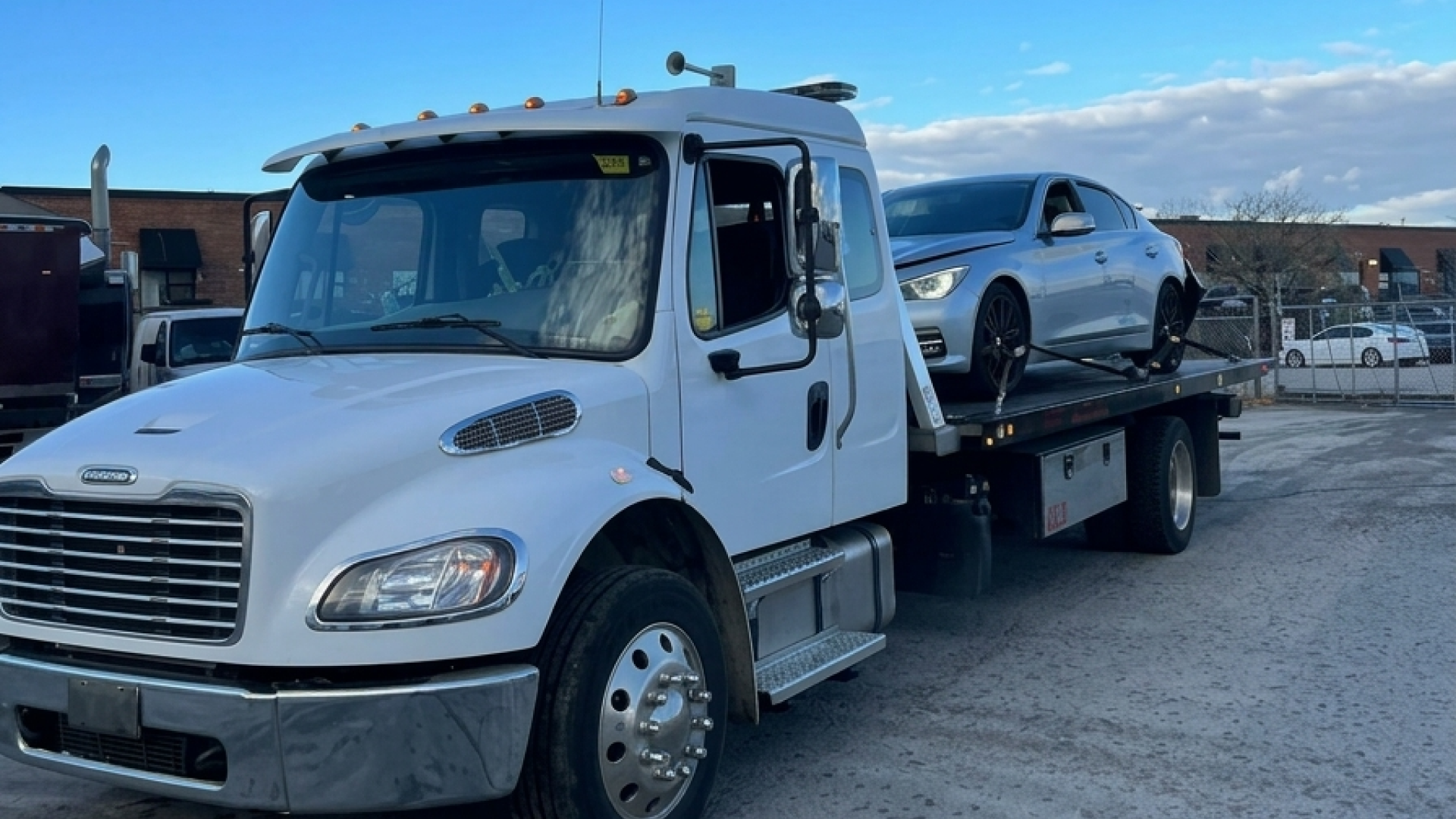
Flatbed Towing
Flatbed towing places the entire vehicle on the bed of the tow truck. Instead of allowing the vehicle's wheels to remain on the road during transportation, the vehicle is loaded onto the platform and secured.
Flatbed towing can be particularly useful for vehicles that have significant damage, certain all-wheel-drive or four-wheel-drive vehicles, specialty vehicles, or cars that should not be moved with their wheels rolling on the roadway.
It can also be useful when a vehicle cannot safely roll under its own wheels.
Recovery Equipment
Vehicle recovery involves situations where a vehicle is stuck, disabled in a difficult position, or located somewhere that makes ordinary towing impractical.
Recovery may involve specialized equipment and careful positioning. A vehicle stuck in a ditch, for example, may need to be recovered before it can be loaded or transported.
The goal is not simply to pull the vehicle free. The recovery process needs to account for the vehicle's condition, the surrounding terrain, available attachment points, and the direction in which the vehicle can safely be moved.
How the Right Equipment Helps Protect Your Vehicle
Selecting appropriate towing equipment can reduce unnecessary stress on a vehicle during transportation.
Protecting the Drivetrain
The drivetrain includes components that transfer power from the engine to the wheels. Depending on the vehicle, this system can include the transmission, driveshafts, differentials, axles, and related components.
Improper towing can potentially place stress on drivetrain components that were not designed to rotate in a particular way while the vehicle is being transported.
This is one reason professional operators consider drivetrain configuration before selecting a towing method.
Reducing the Risk of Additional Body Damage
A damaged vehicle may have loose panels, compromised bumpers, damaged suspension components, or other vulnerable areas.
Using equipment that provides appropriate support can help reduce unnecessary contact or pressure during loading and transportation.
After an accident, this consideration becomes especially important because some damage may not be immediately visible.
Supporting Vehicles With Wheel or Suspension Problems
A vehicle with a damaged wheel, axle, steering component, or suspension may not be safe to move like an ordinary operational vehicle.
Attempting to move a car with a damaged wheel can create additional problems. In these situations, specialized towing or recovery equipment may be necessary to move the vehicle without placing unnecessary stress on damaged components.
Helping Maintain Vehicle Stability
Proper loading and securement are critical parts of professional towing. The vehicle needs to remain stable during transportation, including while the tow truck accelerates, brakes, turns, and travels over uneven sections of roadway.
Equipment selection and securement should match the vehicle being transported.
How Towing Equipment Is Selected for Different Vehicles
The right towing method can vary even among vehicles that appear similar.
Passenger Cars
Most ordinary passenger cars fall into the light-duty towing category, but the specific towing method still depends on the vehicle's condition and drivetrain.
A running car with intact wheels and steering may present a very different towing situation from a car that has been involved in a collision.
SUVs and Pickup Trucks
SUVs and pickup trucks can have greater weight, different wheelbases, higher ground clearance, or four-wheel-drive and all-wheel-drive systems.
These characteristics may influence the appropriate towing equipment.
A professional assessment helps determine whether light-duty towing equipment is suitable or whether another method is preferable.
Vehicles Damaged in Accidents
Accident-damaged vehicles require extra attention because visible damage does not always tell the complete story.
A collision can affect steering, suspension, wheels, axles, or other components. If the vehicle cannot roll or steer normally, attempting to tow it using an unsuitable method may make the situation worse.
Vehicles Stuck Off the Road
A vehicle stuck in a ditch, mud, soft ground, or another difficult location may require recovery rather than conventional towing.
The operator first needs to determine how the vehicle is positioned and what equipment can safely move it. Recovery should be controlled rather than based on simply applying as much pulling force as possible.
Towing Capacity vs. Vehicle Condition: Why Both Matter
A common misconception is that if a tow truck is powerful enough, it can safely tow any vehicle.
That is not necessarily true.
Towing capacity addresses the amount of weight equipment is designed to handle, but vehicle condition determines how that weight can safely be supported and moved.
For example, imagine two vehicles with similar weights. One has a flat tire and an otherwise intact suspension. The other has collision damage affecting the front wheel and steering system. Their towing requirements may be completely different.
Weight Is Only One Part of the Assessment
Professional towing decisions can involve several questions:
How much does the vehicle weigh?
Can the vehicle roll normally?
Can the wheels turn normally?
Is the steering functional?
Is the suspension damaged?
Is the vehicle's drivetrain suitable for the proposed towing method?
Can the vehicle be safely loaded and secured?
Is the vehicle in a position that requires recovery first?
These questions help determine which equipment is appropriate.
What Can Go Wrong With Improper Towing?
Using unsuitable towing equipment can create several problems.
Drivetrain Damage
Certain towing methods can cause unwanted rotation of drivetrain components. If the vehicle requires a particular transportation method but is towed incorrectly, expensive mechanical components may be exposed to unnecessary stress.
Tire and Wheel Problems
A damaged tire or wheel may not be suitable for normal road contact during a tow. Continuing to roll a compromised wheel assembly can potentially worsen existing damage.
Suspension and Steering Damage
If steering or suspension components are already damaged, towing in a way that places additional force on those components can create further problems.
Body and Undercarriage Damage
Improper attachment points, loading methods, or equipment positioning can create contact with vulnerable parts of the vehicle.
This is particularly concerning for low-clearance vehicles or vehicles with existing accident damage.
When Is Flatbed Towing a Better Choice?
Flatbed towing is often considered when keeping all four wheels off the road is beneficial for the vehicle's condition or configuration.
Situations where flatbed transportation may be appropriate include:
Accident-damaged vehicles
Vehicles that cannot roll normally
Certain all-wheel-drive vehicles
Vehicles with significant wheel or suspension damage
Vehicles requiring additional protection during transportation
Vehicles that need to be moved without relying on their own wheels
The final choice should be based on the specific vehicle and situation rather than assuming every car requires the same towing method.
How Professional Towing Helps During a Roadside Emergency
A roadside emergency is rarely convenient. Drivers may be dealing with traffic, poor weather, an unfamiliar location, or uncertainty about what caused the problem.
Professional towing assistance provides more than transportation. It can help determine what type of roadside response is appropriate.
For example, a vehicle with a dead battery may only need a jumpstart service. A car with a flat tire may require roadside assistance rather than towing. A vehicle involved in a collision may need transportation on a flatbed. A vehicle stuck off the roadway may require winch-out services before it can be transported.
Matching the response to the actual problem helps avoid unnecessary handling.
What Drivers Should Do Before a Tow Truck Arrives
There are several practical steps drivers can take while waiting for a tow truck.
Move to a Safe Location if Possible
If the vehicle can be moved safely, get it away from active traffic and into a safer location. Do not attempt to drive a vehicle that may have serious mechanical, steering, brake, or collision damage.
Turn on Hazard Lights
Hazard lights can help make a disabled vehicle more visible to approaching drivers, particularly at night or in poor visibility.
Avoid Attempting Risky Repairs
A roadside emergency is not the time to attempt repairs that could expose you to traffic or further damage the vehicle.
If you are unsure whether the vehicle can safely move, wait for professional assistance.
Tell the Towing Provider What Happened
Useful information can include:
Vehicle make and model
Exact location
Type of problem
Whether the vehicle starts
Whether the wheels roll
Whether there is accident damage
Whether the vehicle is stuck
Whether a tire, wheel, or suspension component is damaged
Accurate information helps the towing provider prepare for the situation.
Common Misconceptions About Towing Capacity
“Any Tow Truck Can Tow Any Car”
Tow trucks are not interchangeable. Different trucks and towing systems are designed for different applications and vehicle sizes.
“A Heavier Tow Truck Is Always Better”
More capacity does not automatically mean a particular setup is best for a specific vehicle. The equipment still needs to be compatible with the vehicle and circumstances.
“If the Car Rolls, It Can Be Towed Normally”
A vehicle may roll but still have damage that affects steering, suspension, wheels, or drivetrain components.
Rolling ability alone does not determine the safest towing method.
“Towing Is Just About Getting the Vehicle From Point A to Point B”
Safe transportation involves loading, support, securement, equipment compatibility, and consideration of the vehicle's condition.
The method used to move a vehicle matters just as much as where it needs to go.
Best Practices for Safe Vehicle Towing
Drivers can reduce complications by choosing a professional towing provider and providing accurate information about the vehicle.
A few practical best practices include:
Explain the vehicle's condition before towing begins.
Mention any accident or mechanical damage.
Tell the operator if the vehicle has all-wheel or four-wheel drive.
Identify damaged tires, wheels, or suspension components.
Explain whether the vehicle is stuck or off the roadway.
Follow the operator's instructions during loading.
Avoid standing near moving towing equipment.
Remove loose personal items from the vehicle when appropriate.
Make sure the destination is clearly communicated.
The more accurately the situation is described, the easier it is to select an appropriate towing approach.
24/7 Towing and Roadside Assistance in Marrero and Nearby Louisiana Areas
A&Z Towing LLC provides 24/7 towing and roadside assistance for drivers who need help in Marrero, Harvey, Gretna, Westwego, and surrounding Louisiana communities.
Services include emergency towing, light-duty towing, flatbed towing, vehicle recovery, and roadside assistance for common problems such as flat tires, dead batteries, lockouts, breakdowns, and accident-related vehicle issues.
For drivers dealing with an unexpected breakdown or disabled vehicle, professional towing can help determine whether the situation calls for roadside service, conventional towing, flatbed transportation, or vehicle recovery.
The key is to describe the vehicle's condition accurately and allow the towing professional to determine the appropriate equipment.
Conclusion
Understanding towing capacity helps explain why professional towing involves more than simply matching a truck with a vehicle.
The vehicle's weight is important, but so are its drivetrain, wheel condition, suspension, steering, ground clearance, accident damage, and location. The right equipment provides appropriate support and helps reduce unnecessary stress during loading, recovery, and transportation.
Wheel-lift systems, flatbeds, and recovery equipment each serve different purposes. Choosing between them requires an assessment of the vehicle and the circumstances surrounding the roadside emergency.
If your vehicle breaks down, is involved in an accident, or becomes stuck, provide the towing provider with as much accurate information as possible. A professional assessment can help determine the safest and most appropriate way to move the vehicle.
For drivers in Marrero, Harvey, Gretna, Westwego, and surrounding Louisiana areas, A&Z Towing LLC provides 24/7 towing and roadside assistance for a wide range of roadside situations. Contact us today for fast, reliable support.
Frequently Asked Questions
What is towing capacity?
Towing capacity is the amount of weight a towing vehicle and its equipment are designed to safely move. The appropriate capacity depends on the tow truck, equipment, vehicle weight, and circumstances of the towing or recovery situation.
Does a heavier vehicle always require a heavy-duty tow truck?
Not necessarily. Vehicle weight is one consideration, but drivetrain, condition, wheel damage, suspension problems, ground clearance, and towing method also affect equipment selection. A professional assessment helps determine the appropriate setup.
Is flatbed towing safer for every vehicle?
Flatbed towing can be an appropriate choice for many vehicles, particularly those with certain drivetrain configurations, significant damage, or wheels that should not remain on the roadway. However, the best method depends on the vehicle and its condition.
Can a damaged vehicle be towed if its wheels still roll?
Possibly, but rolling wheels do not automatically mean the vehicle can be conventionally towed. Steering, suspension, wheel, axle, and drivetrain damage should be considered before transportation.
Why does drivetrain type matter when towing a vehicle?
Front-wheel drive, rear-wheel drive, all-wheel drive, and four-wheel drive vehicles can have different towing requirements. Certain towing methods may cause unwanted rotation of drivetrain components, so the vehicle's configuration should be considered when selecting equipment.
What type of towing is used for a vehicle stuck in a ditch?
A vehicle stuck in a ditch may require vehicle recovery rather than ordinary towing. The appropriate equipment depends on the vehicle's position, terrain, condition, available attachment points, and the safest direction for recovery.
Can roadside assistance help with a dead battery or flat tire?
Yes. Roadside assistance can address common problems such as dead batteries and flat tires. Depending on the condition of the vehicle and the problem, the appropriate response may be a jump-start, tire assistance, or towing if the vehicle cannot safely continue.
What information should I provide when requesting a tow?
Provide your exact location, vehicle make and model, description of the problem, whether the vehicle starts or rolls, any accident damage, and whether the vehicle is stuck or has wheel, tire, steering, or suspension damage. Accurate information helps determine the appropriate equipment.
What should I do if my vehicle breaks down on a busy road?
If possible, move to a safer location without driving a vehicle that may be unsafe. Turn on hazard lights, stay aware of surrounding traffic, and request roadside assistance. Avoid standing in traffic lanes or attempting risky repairs while waiting for help.
What areas can a towing company serve around Marrero, Louisiana?
Towing providers serving Marrero may also assist drivers in nearby communities such as Harvey, Gretna, Westwego, and surrounding areas. Service availability can depend on the provider, location, traffic conditions, and type of roadside assistance required.